The Flying Wing With No Tail
Northrop’s YB-49 was all wing — no fuselage “tube,” no normal tail — a 1940s preview of today’s B-2 shape.
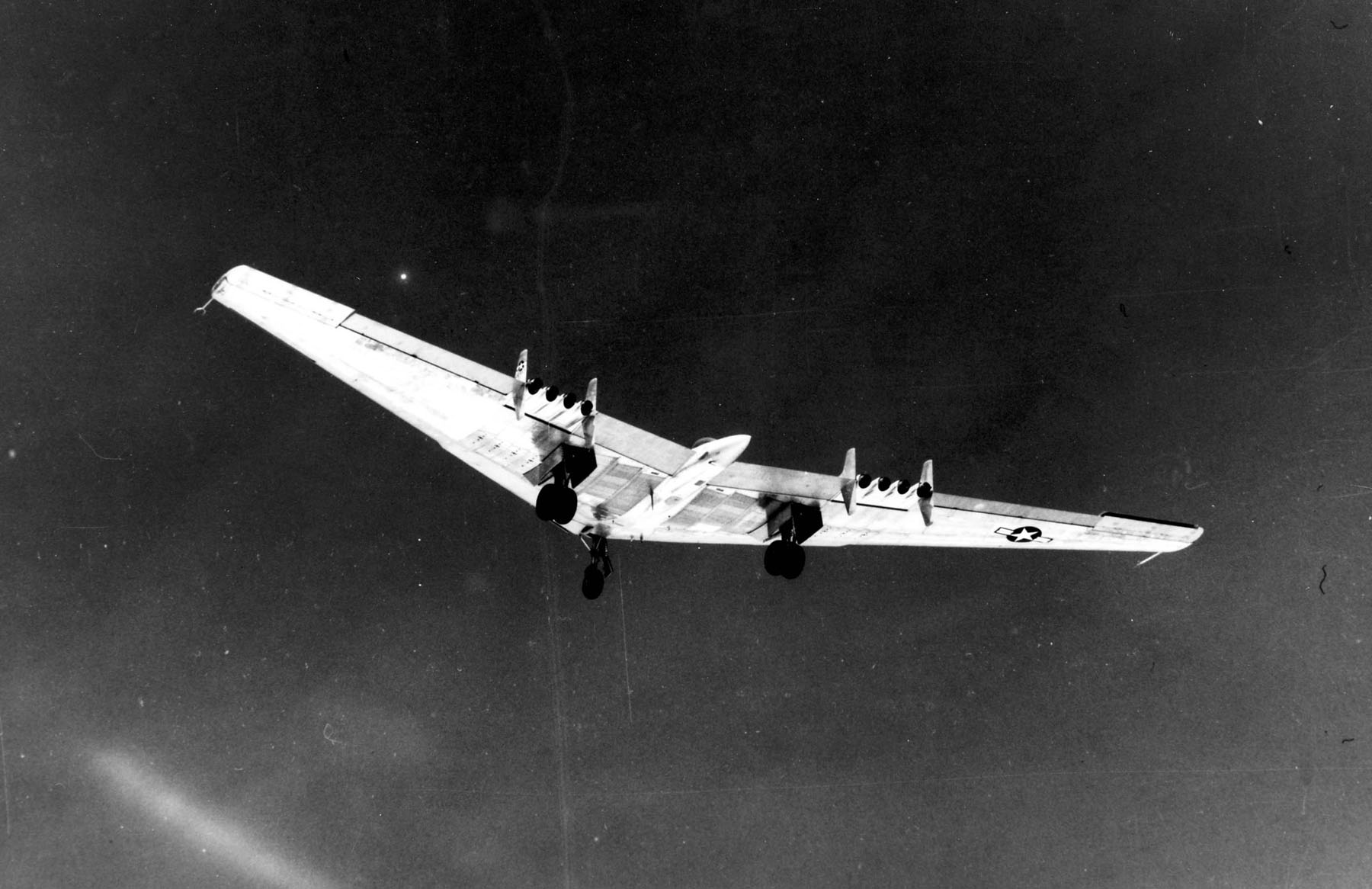
All wing, no tube
Jack Northrop’s YB-49 looked like someone forgot the airplane and kept only the wing. No long fuselage tube. No conventional tail sticking up. Just a broad flying wing with jet engines buried in the trailing edge.
The YB-49 was a jet conversion of Northrop’s earlier propeller-driven XB-35 idea. The first YB-49 flew in October 1947. The shape chased low drag: if almost everything is wing, almost everything makes lift, and there is less “extra” skin to haul through the air.
That same cleanliness made the airplane sensitive. Without a long tail for leverage, stability and control had to come from careful surfaces on the wing itself. Engineers argued about how a flying wing should behave in stalls and recoveries. Those arguments were not abstract. They were flight-test reality.
Research, not a poster
This hangar story stays on the engineering side. The YB-49 was a bomber prototype in Air Force paperwork, but what matters here is the shape experiment: can you fly a useful heavy airplane with almost no fuselage?
Flight tests showed promise — long high-altitude legs, high speed for the day — and hard limits. On 5 June 1948 the second YB-49 broke up on a test flight near Muroc (later Edwards) Air Force Base. Five crew members were killed, including Capt. Glen Edwards, for whom the base was later renamed. A structural failure tore the outer wing panels away. The program’s luck never recovered; the remaining jet wing later suffered a taxi accident, and the Air Force moved on.
Decades later, Northrop’s B-2 Spirit proved a mature flying-wing bomber could work with modern flight controls. The YB-49 sits in that lineage as an early, risky chapter — not as a combat highlight reel.
Why the shape still matters
Captain, ten, draws the YB-49 next to a normal bomber and circles the missing tail. Co-Pilot, eight, wants to know where the bathroom goes if there is no tube. Wingman, six, says it looks like a boomerang that got a job.
Modern airliners are mostly still tubes-with-wings because passengers, cargo doors, and pressurization like a long cabin. Blended-wing and flying-wing research keeps returning because drag and fuel still matter. The YB-49 is the black-and-white photo that says the idea is older than the computers that finally tamed it.
Try this: cut-the-tail glider
Fold a paper plane. Fly it once and note the path. Now snip most of the rear “fuselage” off and retape tiny fins on the trailing edge of the wing. Launch again. Expect squirrely flight. That twitchiness is a soft echo of why flying wings need careful design — and why early ones demanded brave test crews.
Paper only. No real aircraft experiments.
Source note
Northrop YB-49 jet flying wing; first flight Oct 1947; derived from XB-35; second YB-49 lost 5 June 1948 near Muroc AFB (five fatalities, including Capt. Glen Edwards); program cancelled; conceptual ancestor to later flying-wing designs such as the B-2.
Crew note
Captain keeps the tone on research and loss, not “cool bomber.” Co-Pilot renamed Muroc to Edwards on the hangar map with a sticky note. Wingman practices saying “no tail on purpose.”