The Plane With Wings On Backwards
The Grumman X-29 wore its wings the wrong way — tips pointed forward, not back. Computers poked the nose about forty times a second. Two jets. Ames-Dryden. Then two museums.
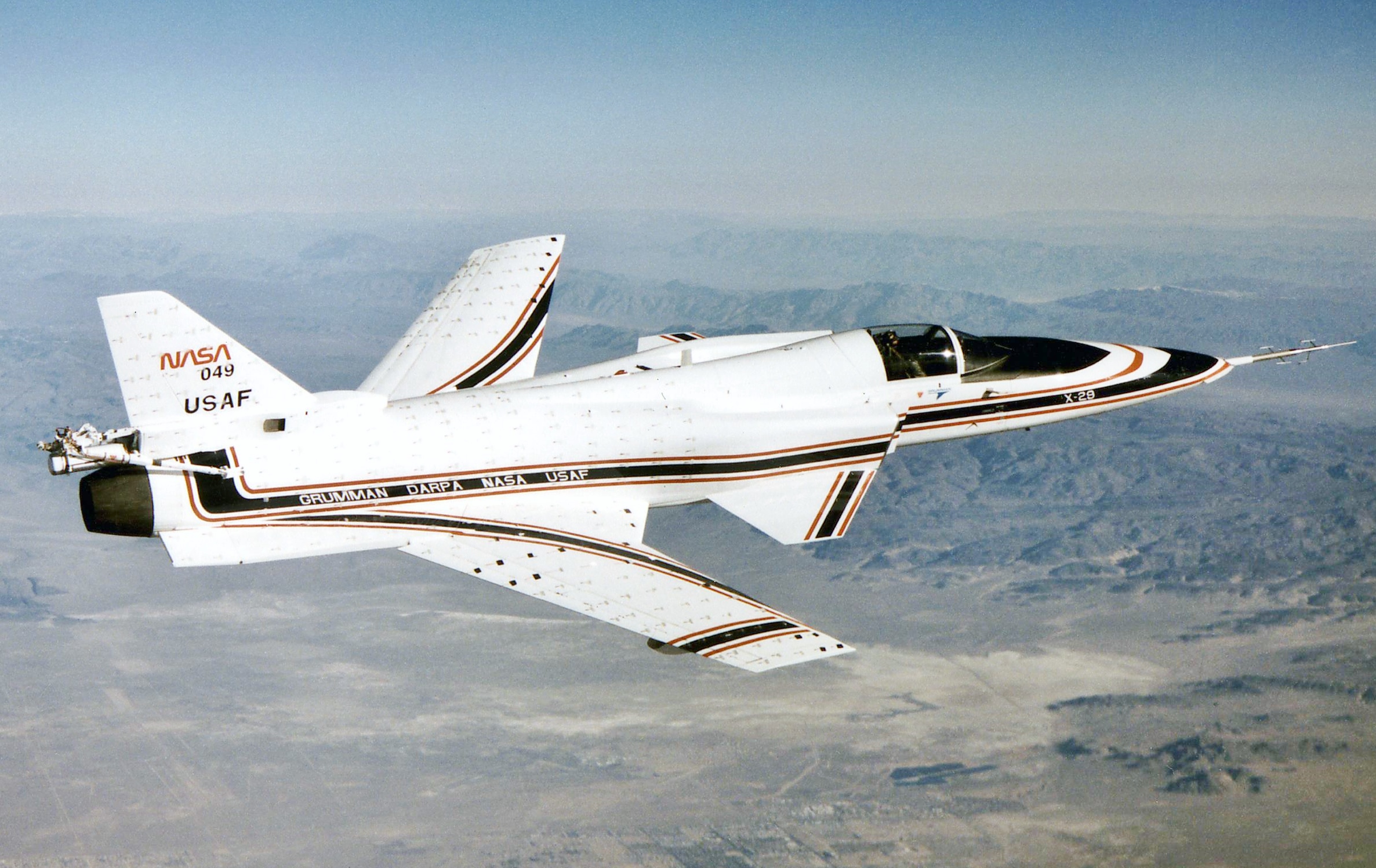
Wings that point the wrong way.
Most jets sweep their wings back, like a dart. The Grumman X-29 swept them forward. The tips sat ahead of the roots. From the side it looked like someone had bolted the wings on backwards and dared the air to complain.
That is not a cartoon trick. Air over a forward-swept wing wants to slide inward toward the body, not out toward the tips. The tips stay “awake” when a regular wing would start to stall. The catch: the same shape wants to twist and tumble. The airplane was unstable on purpose. Three digital computers, with analog backups, poked the nose about forty times a second so a human could still fly it.
Wingman Levi, six, said it looked like a paper dart thrown the wrong way on purpose. Captain Jacob, ten, wrote FORWARD ≠ BACKWARDS on the board and made everyone look at the photo until they saw the tips pointing at the nose.
Little canards — tiny wings near the cockpit — shared the lift and did most of the pitch work. The main wings sat far back. Cover the canards with a thumb and the leftover shape still looks like it is flying backward.
Two jets, one desert homework
Grumman built two. NASA, DARPA, and the Air Force paid for the homework together. The shop borrowed a fighter nose from the F-5 family and landing gear from an F-16, then wrapped a new body, new canards, and those backwards wings around a General Electric F404 engine.
Both first flights left NASA’s Ames-Dryden Flight Research Facility at Edwards, California — the desert strip later called Dryden, then Armstrong. No. 1: 14 December 1984. No. 2: 23 May 1989. The program ran from 1984 into 1992.
No. 1 answered the first questions: does a forward-swept wing behave, and can a pilot live with the computers? On 13 December 1985 it became the first forward-swept airplane to go faster than sound. No. 2 wore little cloth tufts so engineers could watch the air. That is the airplane in the photo. Its job was high angle of attack — pointing the nose up steep while still flying — and whether a fighter-shaped jet could use the trick. NASA wrote that the shape still answered the stick up to about 45 degrees.
NASA counted 422 research flights: 242 on No. 1, 120 on No. 2, and 60 more in a follow-on vortex-control phase.
Co-Pilot Isaac, eight, wanted to know if you could fly it with the computers off. Captain said no, and that is the honest hangar sentence. Unstable on purpose is a feature only if the boxes keep ticking.
What the hangar keeps
Fighter jets did not copy the backwards wings. Other ideas won. What the X-29 kept for later airplanes is quieter: strong composite wings that can be tailored so they bend a little but refuse to twist off, and computers that can fly a shape a human could not hold alone.
No. 1 sits in the Research and Development Gallery at the National Museum of the United States Air Force in Dayton, Ohio. It arrived in late 1994. No. 2 sits at NASA Armstrong at Edwards. You can walk up and check the tips. They still point the wrong way.
Try this: backward Dart vs forward Dart
Fold The Dart the usual way, wings swept a little back. Fly it once down the hallway.
Now fold a second Dart and cheat the wings: slide both tips a little forward before you tape the middle, so the wing looks like a V pointing at the nose. Same throw. Same hallway.
The regular Dart tracks. The forward one may snap, roll, or dive. That is the X-29 lesson without a desert: a wing that points the “wrong” way changes how air pushes, and it can feel twitchy. If your forward Dart immediately corkscrews, flatten the sweep a bit and try a small forward angle first, the way the real program started with computers doing forty tiny saves a second.
Do not throw at faces. The brothers only approve hallway tests.
Source note
Grumman X-29 advanced technology demonstrator; joint NASA–DARPA–Air Force program; Grumman $87 million contract Dec 1981 for two aircraft; first new X-series in more than a decade; F-5-family nose / F-16 landing gear / GE F404 (~16,000 lbf); thin supercritical composite forward-swept wing with aeroelastic tailoring; canards + flaperons + strake flaps; digital fly-by-wire (~40 corrections/s) with analog backup; designed aerodynamically unstable; Ames-Dryden (Edwards; later Dryden / Armstrong); No. 1 first flight 14 Dec 1984; No. 2 first flight 23 May 1989; program 1984–1992 (No. 2 flown May 1989–Aug 1992); first forward-swept supersonic 13 Dec 1985 (No. 1); high-AoA / military-utility work on No. 2; NASA: excellent control to ~45° AoA; 422 research missions (242 Phase 1 / No. 1; 120 Phase 2 / No. 2; 60 vortex-control follow-on); No. 1 (82-0003) to National Museum of the USAF, Dayton, OH, late 1994; No. 2 (82-0049) on display at NASA Armstrong. Photo: NASA Ames-Dryden/Armstrong EC90-039-4, public domain, NASA / Larry Sammons, Wikimedia Commons (File:Grumman-X29-InFlight.jpg). NASA pages: X-29 Advanced Technology Demonstrator; image article EC90-039-4.
Crew note
Captain will not let anyone say the wings are on backward by accident. Co-Pilot keeps drawing a dart, flipping the wings, and labeling the flip “on purpose.” Wingman named the paper one Wrong-Way 049, which is the NASA number on the tufted jet plus the correct insult.