The Jet That Hung From a Hook
Ryan’s X-13 Vertijet was a jet that took off standing up — then hung itself on a trailer cable to come home. Two built. Edwards. Then two museums.
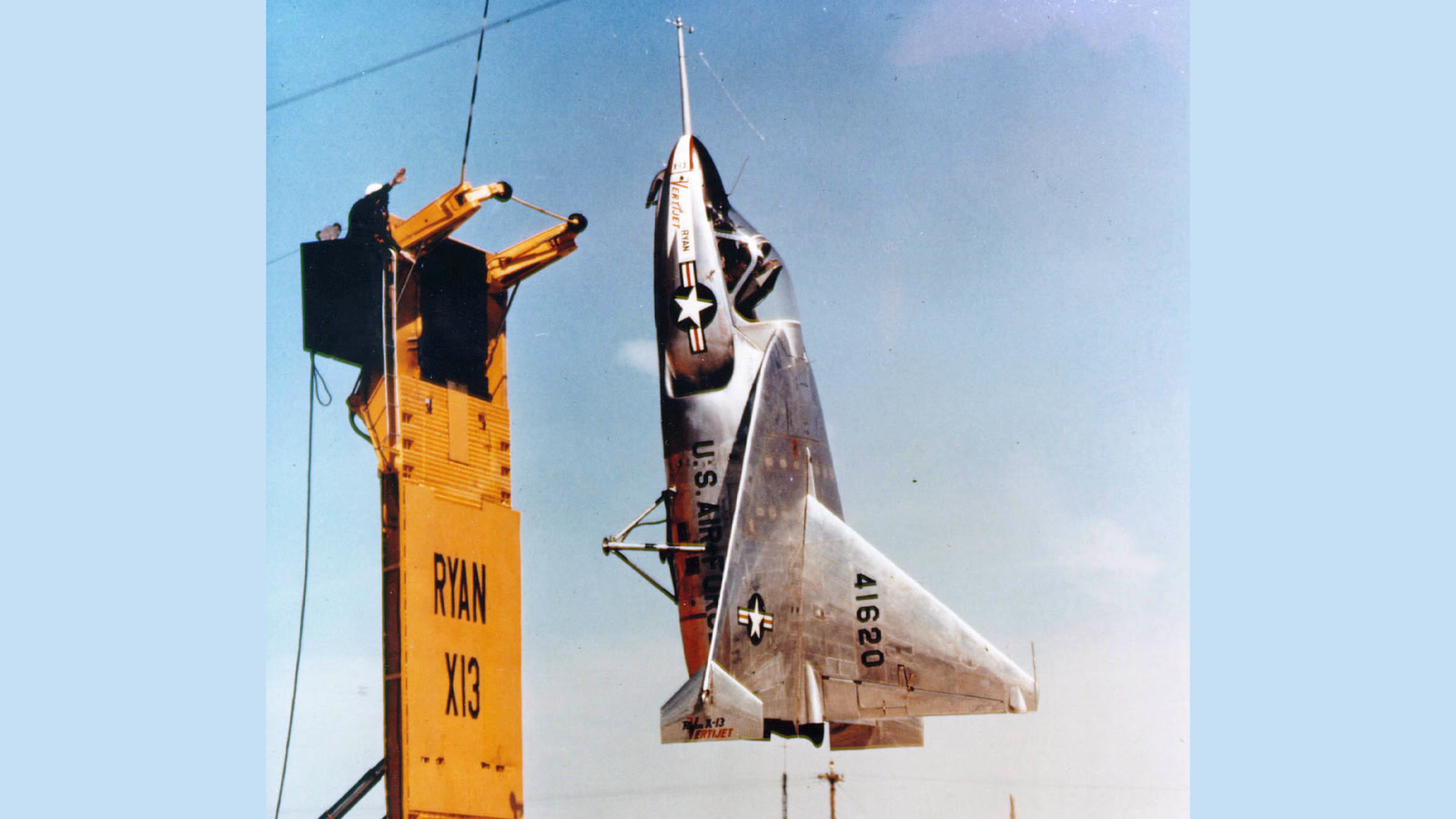
A jet that hangs like a coat.
Most airplanes park on their bellies. The Ryan X-13 Vertijet hung from a hook, nose to the sky, on a yellow trailer that could stand up like a wall.
Ryan Aeronautical built it in San Diego. The shop name was Model 69. The Air Force name was X-13. The job was not “build a fighter for next year.” The job was homework: can a pure jet take off standing up, tip over onto its wing, fly like an ordinary airplane, then stand up again and catch a cable?
That last part is the whole trick. The Navy already had a tailsitter with a giant propeller and four little wheels — a different airplane, a different parking lot. The Vertijet used a Rolls-Royce Avon turbojet, about 10,000 pounds of thrust, and a hook under the nose. No landing gear on the real job. The trailer was the airport. After the jet hooked the cable, the crew tilted the trailer flat and towed the airplane away like a boat on a rack.
The machine was tiny. About 23 feet 5 inches long. Wings only 21 feet across — a high delta with flat plates on the tips. A short pole stuck out near the hook so the pilot could judge how close the trailer was. The seat tilted so he was not staring straight at the sky the whole time. In the hover, the engine’s exhaust did most of the pointing. Little puffer jets at the wingtips handled roll.
Wingman Levi, six, said it looked like a dart someone hung on a coat hook and forgot. Captain Jacob, ten, wrote HOOK ≠ WHEELS on the board and made everyone look at the yellow box that says RYAN X13 until they saw the cable arm.
Two jets. One trailer trick.
Ryan built two. First was 54-1619. They bolted on temporary wheels and flew it like a regular airplane on 10 December 1955 at Edwards Air Force Base, California. Ryan’s chief test pilot Peter F. “Pete” Girard was in the seat. That flight was for ordinary flying qualities — does the delta behave? — before anyone asked it to stand up.
Then the shop swapped the wheels for a steel-tube tail stand with caster wheels. On 28 May 1956 the first jet hovered from that stand. The same day, the second jet — 54-1620, the one in the photo, the one painted 41620 on the wing — flew for the first time.
They practiced the hard part on a thick rope strung between towers. The nose was wood for a while, easy to replace if someone bumped the hook. On 28 November 1956 Girard tipped from level flight to standing up and back again, still in the air, not yet from the trailer.
The full loop came on 11 April 1957. 54-1620 rose vertically from the raised trailer at Edwards, nosed over onto the wing, flew for several minutes, stood up again, sank, and hooked the landing wire. That is the sentence the Air Force museum still writes. Ryan test pilot W. L. “Lou” Everett flew the program too.
On 30 July 1957 the second jet showed the trick at the Pentagon. Take off from the trailer. Cross the river. Hang it back up. The museum in Dayton is quieter about the crowd. The homework still counts: a jet did the stand-up trip in front of Washington, not only in the desert.
What the hangar keeps
It worked. That was not enough.
The X-13 proved a jet can take off vertically, fly on the wing, and land vertically on a hook. The Air Force did not have a job that needed a fighter that hangs on a truck. The airplane was not fast enough to be a real interceptor — museum speed is about 350 miles an hour — and hanging on a cable is a hard ask for an ordinary pilot. The program ran out of money and out of a reason. It shut down in 1958.
Later jets that rise straight up kept regular wheels and used a different trick. The hook-and-trailer airport did not become the way.
54-1620 went to the National Museum of the United States Air Force in Dayton, Ohio, in May 1959. It still sits in the Research and Development Gallery. 54-1619 belongs to the Smithsonian’s National Air and Space Museum and lives on loan at the San Diego Air & Space Museum’s Gillespie Field Annex — Ryan’s hometown, with a trailer mockup nearby.
Co-Pilot Isaac, eight, wanted to know if you could miss the hook. Captain said that is why they practiced on a rope and a wooden nose. The photo is the real catch: jet, cable arm, yellow wall.
Try this: hook Dart vs belly Dart
Fold The Dart the usual way. Fly it once down the hallway. That is belly parking.
Now tape a paperclip under the nose as a hook. Stand a cereal box on end as the trailer. Hang the Dart on the box by the clip. That is X-13 parking.
Pick the Dart up so it points at the ceiling. Tip it slowly until it “flies” level. Then stand it up again and try to hang the clip on the box without knocking the box over. Same hallway. Same throw is not the point — the hang is.
If you miss the clip, you just met the Vertijet’s actual job. The Pogo’s job was kissing four wheels while looking over your shoulder. This job is catching a cable. Do not mix them up.
Do not throw at faces. The brothers only approve hallway tests.
Source note
Ryan X-13 Vertijet (company Model 69); two built (54-1619, 54-1620); Ryan Aeronautical, San Diego; USAF jet VTOL research, not a production fighter; Rolls-Royce Avon ~10,000 lbf; length 23 ft 5 in; span 21 ft; high delta with tip endplates; nose hook + distance pole; tilting seat; hover pitch/yaw by vectored thrust, roll by wingtip puffer jets; trailer was dual-role transport/launch/recovery platform (raise to vertical, hook the cable, lower flat to tow); 54-1619 first flight 10 Dec 1955 Edwards, temporary tricycle gear, Pete Girard; tail-stand hover 28 May 1956; 54-1620 first flight 28 May 1956; first in-air horizontal–vertical–horizontal conversion 28 Nov 1956; first full-cycle trailer takeoff / wing-borne flight / trailer hook landing 11 Apr 1957 at Edwards (54-1620, Girard); Ryan test pilot W. L. “Lou” Everett also flew; Pentagon / Washington demonstration 30 July 1957; program ended 1958 (concept proved; limited operational use; no requirement / funding); NMUSAF: max speed ~350 mph, ceiling 20,000 ft, max weight 7,200 lb; 54-1620 to National Museum of the U.S. Air Force, Dayton, OH, May 1959 (Research and Development Gallery); 54-1619 transferred to Smithsonian NASM (A19600018000), on loan at San Diego Air & Space Museum Gillespie Field Annex. Photo: USAF, PD-USAF / public domain, 1957, Edwards; second prototype 54-1620 about to moor to dual-role trailer; Wikimedia Commons (File:Ryan_X-13.jpg); Edwards AFB X-series gallery (archived). NMUSAF X-13 fact sheet; Smithsonian NASM collection object A19600018000; Wikipedia / VTOL.org milestone cross-check on the 11 Apr 1957 full-cycle date.
Crew note
Captain will not let anyone call it the Pogo. Different shop, different engine, different parking. Co-Pilot keeps drawing a yellow box labeled TRAILER and a paperclip labeled HOOK. Wingman named the paper one Coat-Hook 1620, which is the serial on the silver jet plus the correct insult.