The Plane Too Loud to Fly
Republic’s XF-84H was a fighter that kept a giant propeller. The tips of that propeller went faster than sound. The airplane did not. Ground crews named it Thunderscreech. Two built. Twelve flights. Then Dayton.
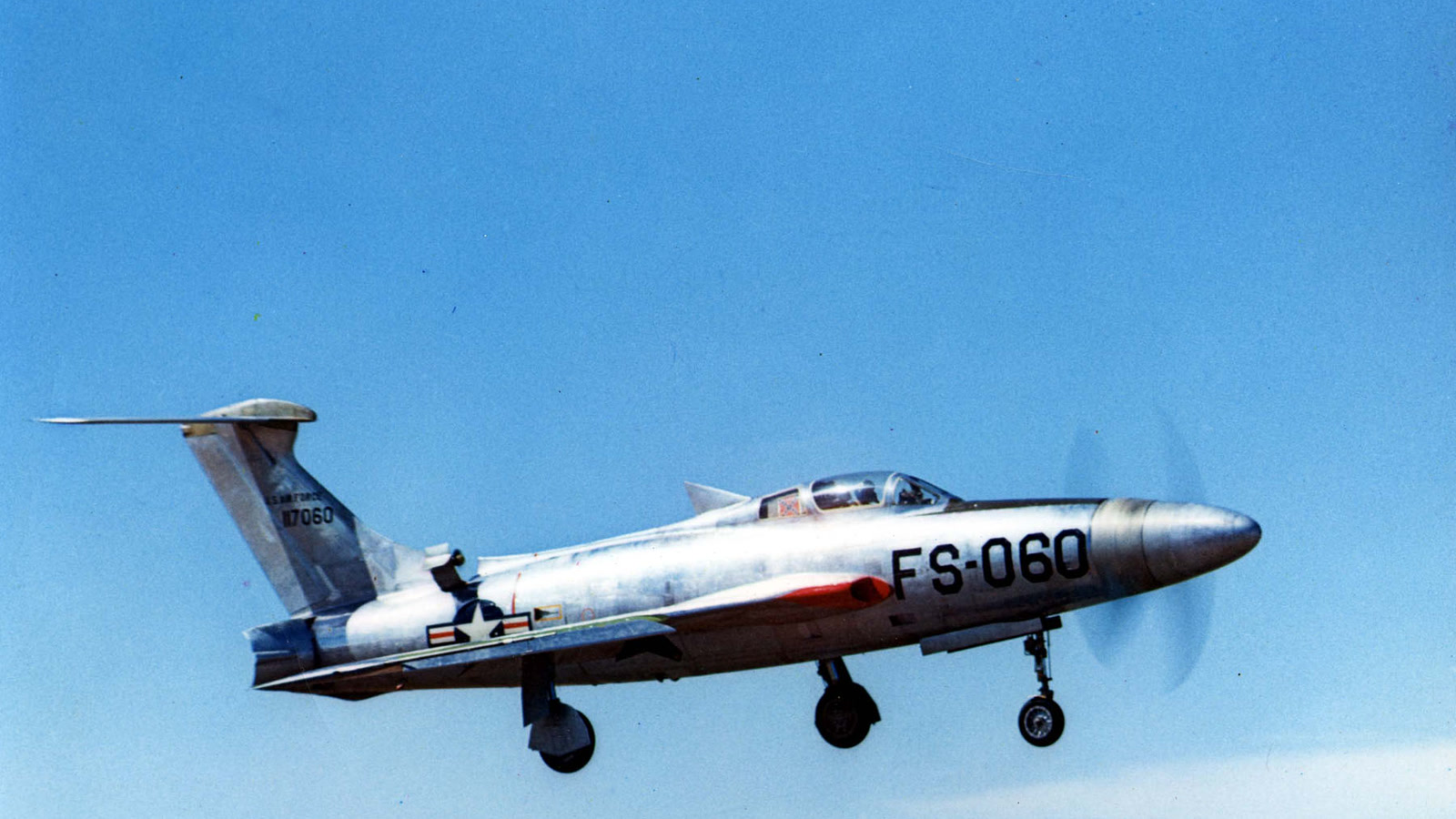
A fighter that kept its propeller.
Most 1950s fighters grew a jet pipe and lost the propeller. Republic’s XF-84H kept a giant one. It was an experimental fighter — not a squadron ship — built from a swept-wing F-84F Thunderstreak. The Air Force and Navy wanted jet speed plus propeller manners: go far, burn less, land slower, still sprint.
The engine was an Allison XT40-A-1 turboprop, about 5,850 shaft horsepower, sitting behind the cockpit and turning a long shaft to a three-blade propeller about 12 feet across. The blades spun so fast that their tips went faster than sound even when the airplane itself did not. That is the whole noise lesson. The airplane never approached supersonic speed. The tips did.
Ground crews named it Thunderscreech. The museum still writes that the sound gave people headaches and made some of them feel sick. We do not need a cartoon scream. The nickname is the fact.
Wingman Levi, six, said it looked like someone bolted a ceiling fan on a dart and dared the desert to complain. Captain Jacob, ten, wrote TIPS ≠ AIRPLANE on the board and made everyone look at the photo until they saw the square-tipped blades, the T-tail, and the little triangle fin behind the cockpit.
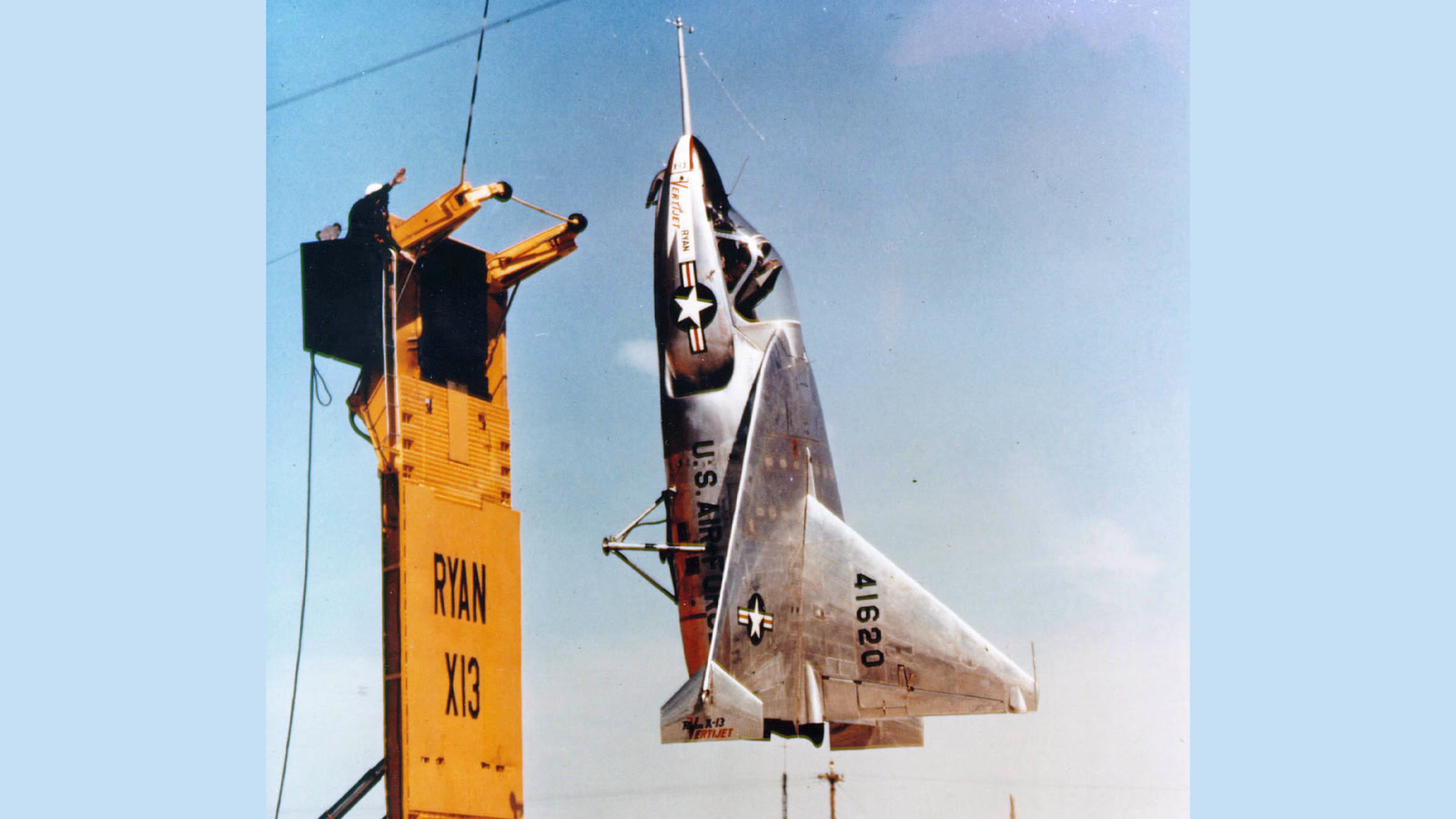
That fin and the T-tail were homework against torque — the twist a huge propeller puts on a skinny fighter. This is not a tailsitter. It parks on its belly like any Thunderstreak. Different job from the Navy Pogo, which stood on its tail with two stacked props. Different job from the X-13, which hung on a hook. Same decade. Different parking lot.
Twelve flights. Then the hangar door.
Republic built two. They shipped them to Edwards Air Force Base, California. First flight: 22 July 1955. Last stretch: October 1956. Between those dates the pair made twelve test flights. The museum says eleven of those twelve ended in emergency landings. The airplane was one of the fastest single-engine propeller ships ever built — museum speed is 520 miles an hour — and it still was not the fighter anyone wanted.
The program was cancelled. Poor performance. Too much maintenance. Never operational.
What the hangar keeps
The first prototype — serial 51-17059 — sat for years at an airport in Kern County, California, then came to the National Museum of the United States Air Force in Dayton, Ohio, in 1999. It flew eight of the twelve test flights. It still sits in the Research and Development Gallery. You can walk up and check the blades. They are still huge.
Co-Pilot Isaac, eight, wanted to know if the airplane itself went faster than sound. Captain said no. The tips did. That is why it was loud, and that is why the nickname stuck.
Try this: tip-speed Dart vs quiet Dart
Fold The Dart the usual way. Fly it once down the hallway. That is a jet-shaped paper ship with no propeller.
Now cut a small card propeller — three square-ish blades — and pin it loosely on a pencil so it can spin. Hold the pencil still and blow on one tip. Watch how the tip travels a longer circle than the hub. That is the XF-84H lesson without a desert: a big blade spinning fast can have tips that outrun the rest of the machine.
Tape a tiny paper disk on the nose of a second Dart so it looks like a prop spinner. Same throw. Same hallway. The paper one will not scream. The real one did, because steel blades the size of a door were going faster than sound at the tips.
Do not throw at faces. The brothers only approve hallway tests.
Source note
Republic XF-84H (unofficial nickname Thunderscreech); experimental turboprop fighter, joint USAF/Navy project based on Republic F-84F Thunderstreak; two built (51-17059 / FS-059, 51-17060 / FS-060); Republic Aviation; Allison XT40-A-1 turboprop ~5,850 shp driving a ~12 ft three-blade propeller (tips supersonic; the airplane itself did not approach supersonic speed); T-tail + triangular dorsal fin to reduce propeller torque; first flight 22 July 1955; last flights October 1956 (museum sign: 22 July 1955–9 October 1956); two airframes made 12 test flights at Edwards AFB, 11 ending in emergency landings; never operational (poor performance / high maintenance); NMUSAF: max speed 520 mph, range beyond 2,000 miles, ceiling above 40,000 ft, weight 17,892 lb; first prototype 51-17059 flew 8 of 12 flights, obtained from Kern County, Calif., 1999, now in Research and Development Gallery, National Museum of the U.S. Air Force, Dayton, OH. Photo is second prototype 51-17060 (FS-060) in flight, 1955/56. Photo: USAF, PD-USAF / public domain; Wikimedia Commons (File:Republic_XF-84H_in_flight.jpg); USAF photo no. 060829-F-1234S-003. NMUSAF XF-84H fact sheet; museum gallery sign; Wikipedia / Aerial Visuals serial cross-check (51-17059 displayed; 51-17060 in the flight photo).
Crew note
Captain will not let anyone call it the Pogo or the Vertijet. Different shop, different parking, different noise. Co-Pilot keeps drawing a 12-foot circle on the board and labeling the rim MACH. Wingman named the paper one Screech Dart 059, which is the serial on the Dayton jet plus the correct insult.