The Little Jet That Lived in a Bomber
McDonnell built a jet with no wheels, a hook on its back, and a plan to live inside a bomber — then catch a trapeze to get home.
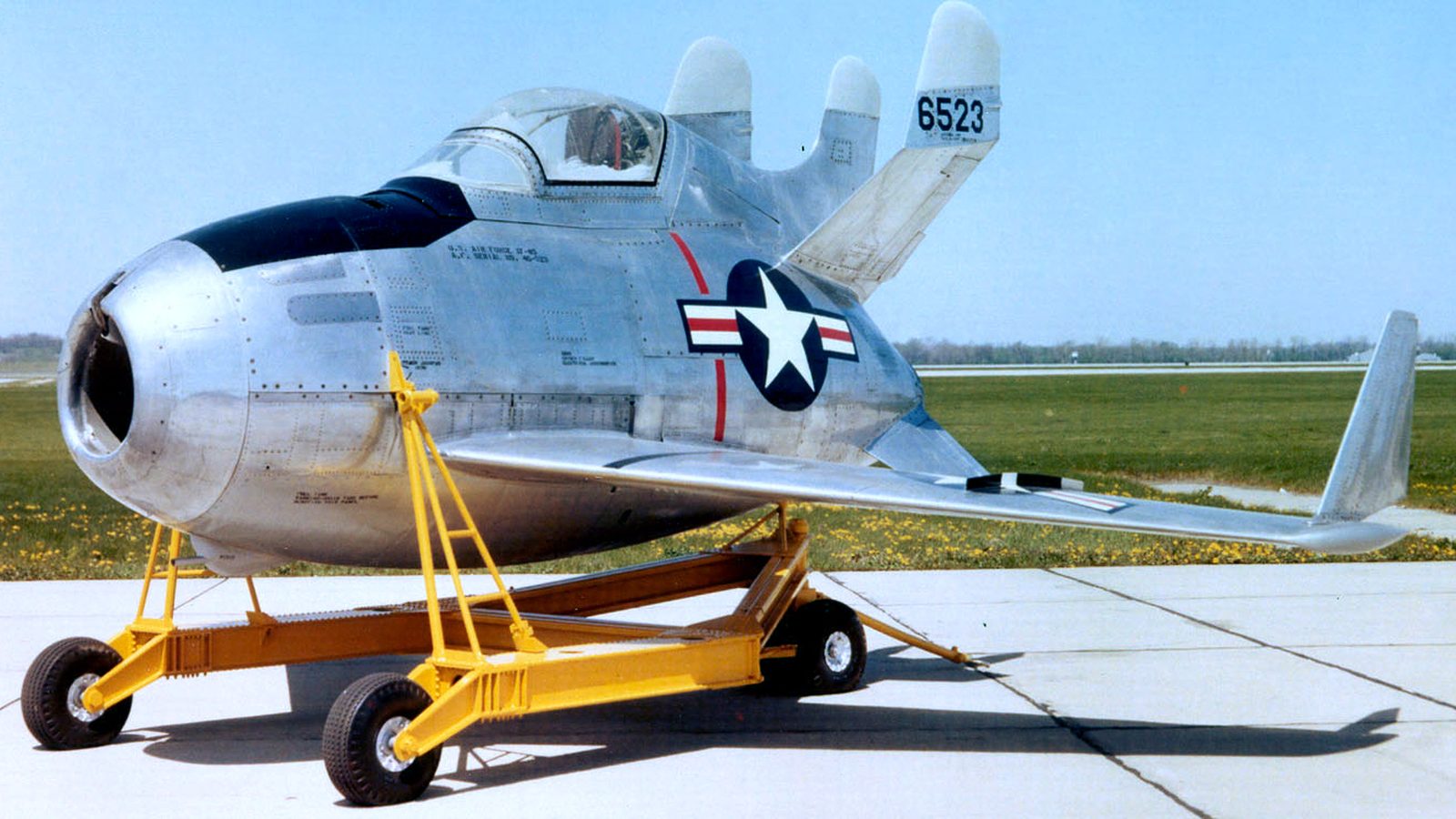
An egg with a hook
Most jets roll on wheels, take off from a runway, and come home the same way. This one was not allowed wheels on purpose.
Picture an egg with stubby wings, a jet pipe in the tail, and a retractable hook on the spine. Length: 14 feet 10 inches. Wingspan with the wings spread: 21 feet 1 inch. Empty weight about 3,740 pounds. The engine was a Westinghouse XJ34-WE-22, about 3,000 pounds of thrust. For tests they added a skid under the belly and little runners on the wingtips.
Wingman, six, says it looks like a bumblebee that forgot its legs. McDonnell called it the Bumble Bee. The U.S. Army Air Forces called it the Goblin. The real name was the McDonnell XF-85. Designer: Herman D. Barkey. They built two.
It was a parasite fighter. A bomber would carry the little jet in its bomb bay, drop it when needed, and winch it home on a trapeze. Wings folded so it could hide in the bay. It was designed for four .50-caliber guns in the nose. Those guns were never installed on the prototypes. Designed for is not the same as flew with.
Drop, fly, catch the bar
A bomber in the 1940s could fly a long way. A small jet of that era could not. So someone asked: what if the fighter hitchhiked?
The mothership for the tests was not a giant B-36. It was a converted EB-29B Superfortress named Monstro — like the whale in Pinocchio. The Goblin hung on a trapeze under Monstro’s belly. A hook on top of the jet was supposed to snag that bar, then a winch would reel it in.
The Goblin could not taxi up and climb aboard. At Muroc — later Edwards Air Force Base — they dug a pit in the tarmac, lowered the jet into the hole, and rolled the bomber over it to hook up. Captain, ten, called that the honest part. If your airplane cannot stand on the ground, you bury a parking space.
Only one person ever flew it: Edwin Foresman Schoch.
Seven flights, three catches
Captive flights — hooked on, not let go — started 23 July 1948.
First free flight: 23 August 1948. About 20,000 feet. About ten minutes. Speeds around 180 to 250 mph. Schoch tried to catch the trapeze. He missed. The canopy smashed. He belly-landed on the dry lake.
First time they both released him and hooked him back: 14 October 1948. That one worked. Other hookups failed on 22 October 1948, 18 March 1949, and 8 April 1949.
Final score: seven free flights. Two hours and 19 minutes in the air, total. Only three successful hookups. Fastest speed they actually measured: 362 mph. Some old brochures talked like it would go much faster. Brochures are not flight logs.
The killer problem was bumpy air under the bomber. The trapeze sat in a messy wake, and the little jet got tossed. Meanwhile, ordinary fighters were starting to take fuel from tanker planes in the air.
Canceled: 24 October 1949.
Why a parasite jet still matters
The Goblin did not fail because it was small. It failed because the parking space was a storm.
You can build a tiny jet. You can hang it under a bomber. Three catches out of seven free flights is not nothing. It still does not mean the sky under a bomber is a hangar. A good idea can also lose to a better habit. Tankers beat parasites.
Both airframes still exist. Number 46-0523 sits at the National Museum of the U.S. Air Force in Dayton, Ohio. Number 46-0524 is at the SAC & Aerospace Museum in Ashland, Nebraska, parked under a B-36J. You can walk up and see how little “inside a bomber” was. Do not call it the smallest jet ever. Call it the jet that tried to live in another airplane.
Try this: the walking trapeze
Fold a tiny paper dart. Tape a bent paper clip on top as a hook. Bend a second paper clip into a small trapeze and tape it to the end of a stick or a ruler.
Walk. Hold the trapeze out. Have a crewmate fly the dart at the bar and try to catch the hook while both of you are moving. Stand still and it feels easy. Walk, and the handshake gets honest. The flights were not the hard part. The catch was.
Source note
McDonnell XF-85 test record (captive flights from 23 Jul 1948; first free flight 23 Aug 1948; first successful release and hookup 14 Oct 1948; canceled 24 Oct 1949); museum airframes 46-0523 (Dayton) and 46-0524 (Ashland).
Crew note
Captain copied the 7 / 3 score onto the hangar whiteboard — seven free flights, three catches — and will not let us round it. Co-Pilot keeps folding hooks onto darts that are already too heavy, then blaming the trapeze. Wingman wants the mothership named Monstro and the dart named Bee, which is fair, because those were already the honest nicknames.