The Spruce Goose That Almost Didn’t Fly
Howard Hughes’s giant wooden flying boat flew only once — for about a mile — and still holds the record for biggest wingspan of any airplane that ever left the water.
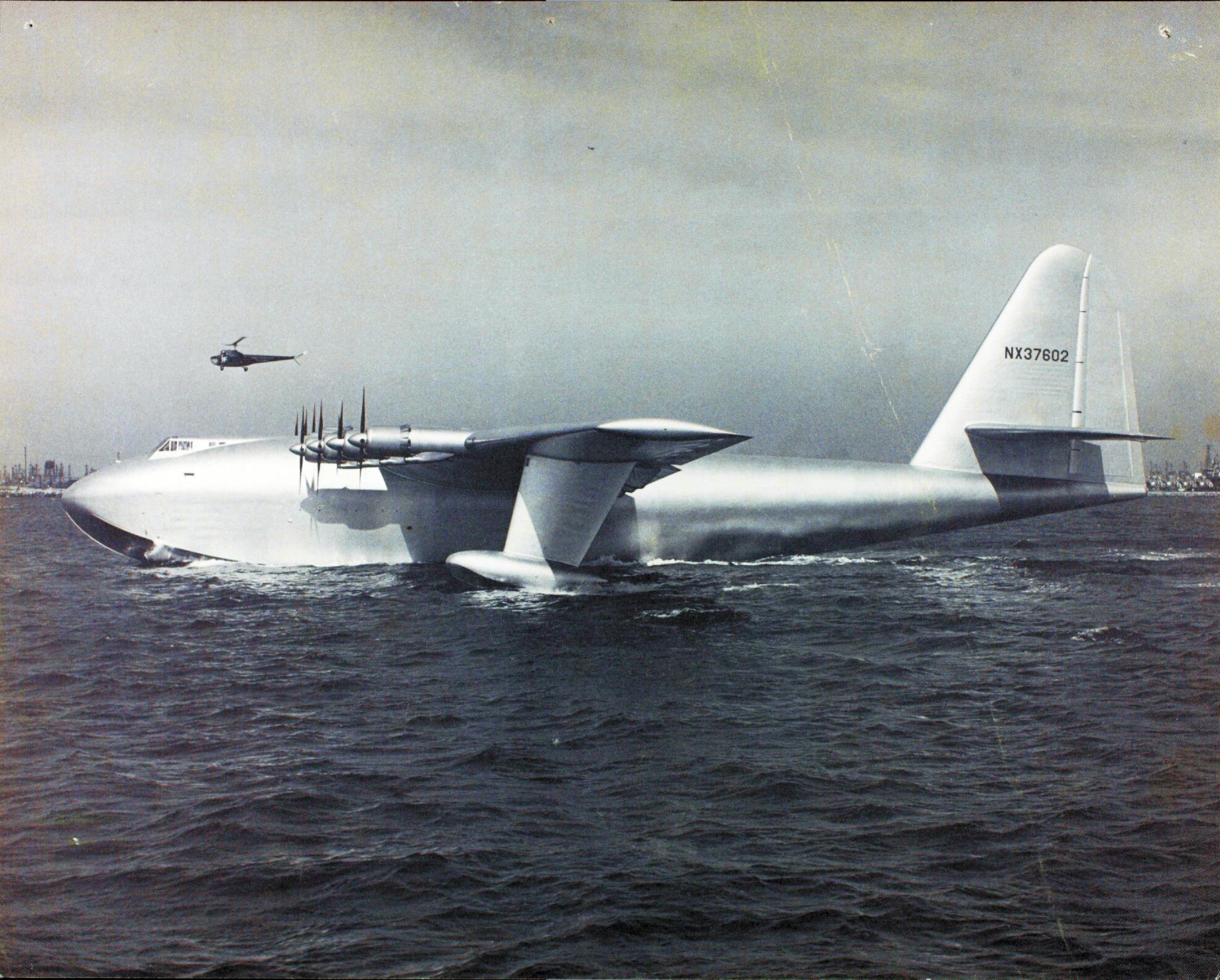
One mile, one flight, biggest wings
Howard Hughes’s H-4 Hercules — the plane everyone calls the Spruce Goose — flew only once. On 2 November 1947 it rose off Long Beach Harbor for about a mile, stayed roughly 70 feet above the water for about half a minute, then set down again. That was the whole flying career.
The wings still stretch about 320 feet tip to tip. For decades that was the widest airplane wing ever to leave the ground (or the water). A later giant finally beat the number, but the Goose still owns the wooden-wingspan story.
It was not spruce. Most of the airframe was birch, laminated with a process called Duramold, because wartime aluminum was scarce and the plane was huge. Eight Pratt & Whitney R-4360 engines — each about 3,000 horsepower — sat along the wings. Hughes wanted a flying boat that could haul troops or cargo across oceans without feeding submarines. The war ended before the ship was ready.
Why build a wooden whale?
Ships were sinking. Airplanes could not yet carry Sherman tanks across the Atlantic. Hughes and shipbuilder Henry Kaiser chased a flying freighter. Kaiser left. Hughes kept going, pouring his own money in after government patience thinned.
The finished flying boat stood about five stories tall. Empty weight ran past a quarter-million pounds. Loaded, the design aimed near 400,000 pounds. Inside, the plan was space for hundreds of people — or two tanks. Outside, it looked like a hangar that learned to float.
Critics said it was a waste. Hughes answered with taxi tests. On the third run he pushed past taxi speed, the hull lifted, and the crowd got its one proof: the wood could fly.
After the hop
It never flew again. Hughes kept the Hercules in climate-controlled storage for years, ready enough to tease the idea of a second try. Today the airplane lives at the Evergreen Aviation & Space Museum in McMinnville, Oregon. You can walk under a wing longer than a football field and see birch where most planes show metal.
The nickname stuck harder than the wood type. Spruce Goose is catchier than Birch Boat. Engineers still talk about the Duramold skins, the eight engines, and the gamble of proving a record-sized wing with a single short hop in ground effect.
Captain, ten, wrote “birch, not spruce” on the hangar board in red. Co-Pilot, eight, measured the wingspan with footsteps until someone stopped him. Wingman, six, calls it the wood whale, which is unfair to whales and perfect for this plane.
Try this: biggest wing wins
Tape two sheets of paper into one long “wing.” Fold a short, stubby paper plane from a single sheet. Launch both from the same height. The long wing floats farther if you keep it light. That is a tiny hint of why Hughes stretched the Hercules so wide — more wing means more lift when the hull is heavy.
Do not glue real wood into a hangar model and claim it will fly a mile. Museum wings already did that once.
Source note
Hughes H-4 Hercules (NX37602); sole flight 2 Nov 1947, Long Beach Harbor (~1 mile, ~70 ft, ~26 seconds); wingspan ~320 ft; primarily birch Duramold construction; eight P&W R-4360 engines; preserved at Evergreen Aviation & Space Museum, McMinnville, Oregon.
Crew note
Captain will not let anyone say “spruce” without a birch correction. Co-Pilot wants eight paper engines on the model. Wingman asked if Hughes could see over the dashboard, which is a fair question on a five-story boat.