The Flying Jeep With Twin Duct Fans
Piasecki’s Airgeep looked like a Jeep that forgot wheels — twin ducted fans in a frame, meant to hop over battlefields (it mostly hopped over test fields).
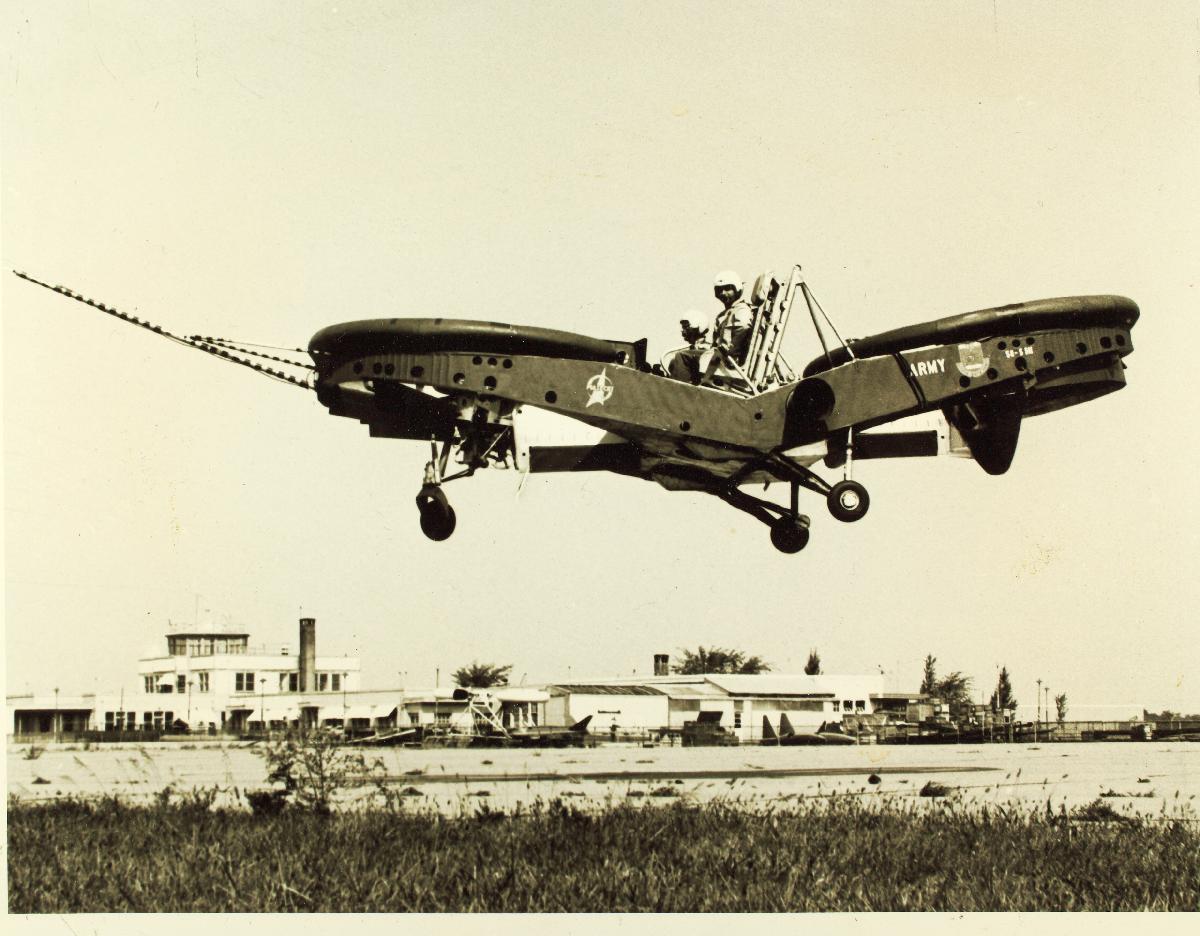
Jeep shape, fan power
Frank Piasecki’s Airgeep (Army designations in the VZ-8 family) was a 1950s–60s experiment in “flying jeeps.” Imagine a open frame with two big ducted fans — one fore, one aft — and seats for a crew who wanted to skip ditches without waiting for bridges.
The idea showed up in both Navy and Army flavors as engineers hunted for a low-flying, roadless utility craft. Turbines or piston engines drove the fans inside rings. Ground effect helped at very low height. Higher hops and real cross-country flying were harder. Stability and power margins kept the Airgeep in the test-field club.
Photos of Airgeep II on early flights look like a science-fair jeep that won a ducted-fan lottery. That visual is why it belongs in Aircraft Fun: pure weird layout, honest limited results.
Why flying jeeps stayed rare
Roads are cheap. Helicopters already lift. A special ducted-fan jeep has to beat both. Noise, dust, engine complexity, and the danger of low flight over rough ground stacked the odds. Later decades reinvented pieces of the dream as multicopters and eVTOL prototypes — different tech, same hunger for vertical utility.
Piasecki’s company name shows up across helicopter history. The Airgeep is the branch where someone said “what if the jeep itself were the aircraft?” and then measured the answer in hover hours instead of highway miles.
Service interest came in waves: maybe a flying jeep could move medics, scouts, or shipboard runners. Each wave met the same wall — complexity versus benefit. Helicopters already existed. The Airgeep had to be simpler or safer or cheaper. Twin ducts in an open frame were none of those at fleet scale, even if they looked perfect in a brochure sketch.
Hangar jeep talk
Captain, ten, writes “test fields > battlefields” so the tone stays engineering. Co-Pilot, eight, built a cardboard Airgeep that only taxi-hops across the rug. Wingman, six, made fan noises until the dog left the room.
Failed production ≠ failed lesson. Twin ducts in a jeep frame teach thrust layout, ground effect, and why “looks obvious” is not the same as “works as a fleet.”
Try this: twin-fan paper jeep
Cut a cardboard “jeep” rectangle. Tape two paper cup duct rings (or toilet-paper tubes) fore and aft. Blow downward through them with your breath or a small hand fan and see how hard steady lift is. Talk about why real Airgeeps needed serious engines.
Cardboard and breath only. No lawn-equipment “duct fans.”
Source note
Piasecki Airgeep / VZ-8 flying jeep family; late 1950s–1960s U.S. service research; tandem ducted fans in an open frame; low-altitude VTOL utility concept; remained experimental; SDASM imagery of Airgeep II early flight.
Crew note
Captain will not let the article turn into war play. Co-Pilot labeled the model “test field only.” Wingman asked for seat belts on the cardboard jeep — approved.