The Solar Wing That Flew Near the Edge of Space
NASA’s Helios was a giant flying wing powered by sunlight — so light and long it set records for altitude without burning a drop of jet fuel.
Sunlight instead of jet fuel
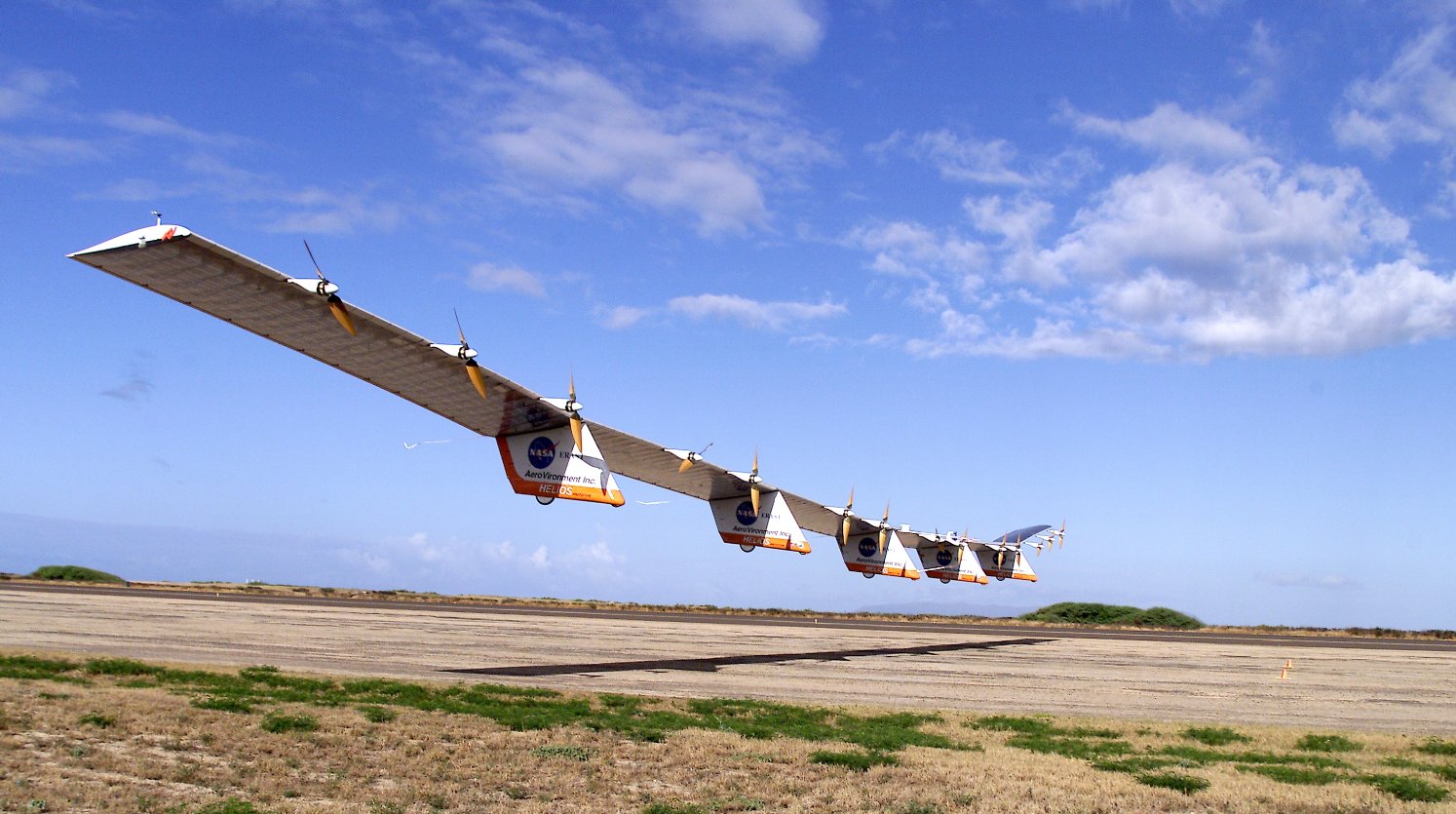
NASA’s Helios Prototype was a flying wing so long and light it looked like a bridge that forgot the river. Built by AeroVironment for NASA, it flew on solar cells and electric motors — no kerosene, no roar of a turbine, just sunlight turned into propeller thrust.
On 13 August 2001, Helios climbed to 96,863 feet over the Pacific near Kauai, Hawaii. That set a world record for sustained horizontal flight by a winged aircraft. It spent more than 40 minutes above 96,000 feet. The air up there is so thin that ordinary planes cannot stay; Helios crawled in that rarefied layer because it was feather-light and had a huge wing.
Wingspan: 247 feet. Chord: only about 8 feet. Fourteen electric motors on the high-altitude configuration. Tens of thousands of solar cells tiled across the upper surface. The structure used composites, foam, and thin plastic skin — more sailplane science fair than airliner.
High and fragile
Helios came from a family of solar research wings (Pathfinder, Pathfinder-Plus, Centurion). The point was high-altitude, long-endurance flight for science and communications ideas — an “atmospheric satellite” concept. Daylight powered the climb. Batteries helped through parts of the flight. A later endurance configuration experimented with hydrogen fuel-cell power.
Fragility was the trade. On 26 June 2003, Helios broke up over the Pacific after atmospheric turbulence and large wing deformations during a test flight. The loss ended the airframe, not the lesson: ultra-light, high-aspect-ratio solar wings can reach astonishing altitudes, but they live close to structural limits when the air gets bumpy.
Why it belongs in the hangar
Captain, ten, circles “no jet fuel” and “96,863 ft” on the same sticky note. Co-Pilot, eight, wants to tape solar-cell candy wrappers on a model wing. Wingman, six, calls it the sun ruler because the wing is longer than a lot of school hallways.
Helios is not a passenger jet and not a fighter. It is proof that propulsion can be quiet and photovoltaic if the airplane is willing to be weird — long, slow, and delicate.
Try this: sunny slow glider
Build the lightest paper glider you can. Tape black paper “solar cells” on top (decoration only). See how little nose weight it needs. Then compare a heavier “jet” dart. Talk about why Helios needed enormous span and tiny weight to climb where the air is thin.
No real solar drones required. Yard paper flights only.
Source note
NASA/AeroVironment Helios Prototype; 247 ft wingspan; solar-electric flying wing; altitude record 96,863 ft on 13 Aug 2001 near Kauai; HP01 high-altitude configuration with 14 motors; lost 26 June 2003 during endurance-configuration testing.
Crew note
Captain files Helios under “HALE research,” not toys. Co-Pilot measured 247 feet in hallway lengths and got tired. Wingman drew the sun wearing sunglasses and a pilot scarf.