The Dinner-Plate Airplane That Almost Hovered
Charles Zimmerman built a wood-and-canvas disk that sat nose-high like a plate on a stand, then flew so slowly people in Connecticut reported a UFO.
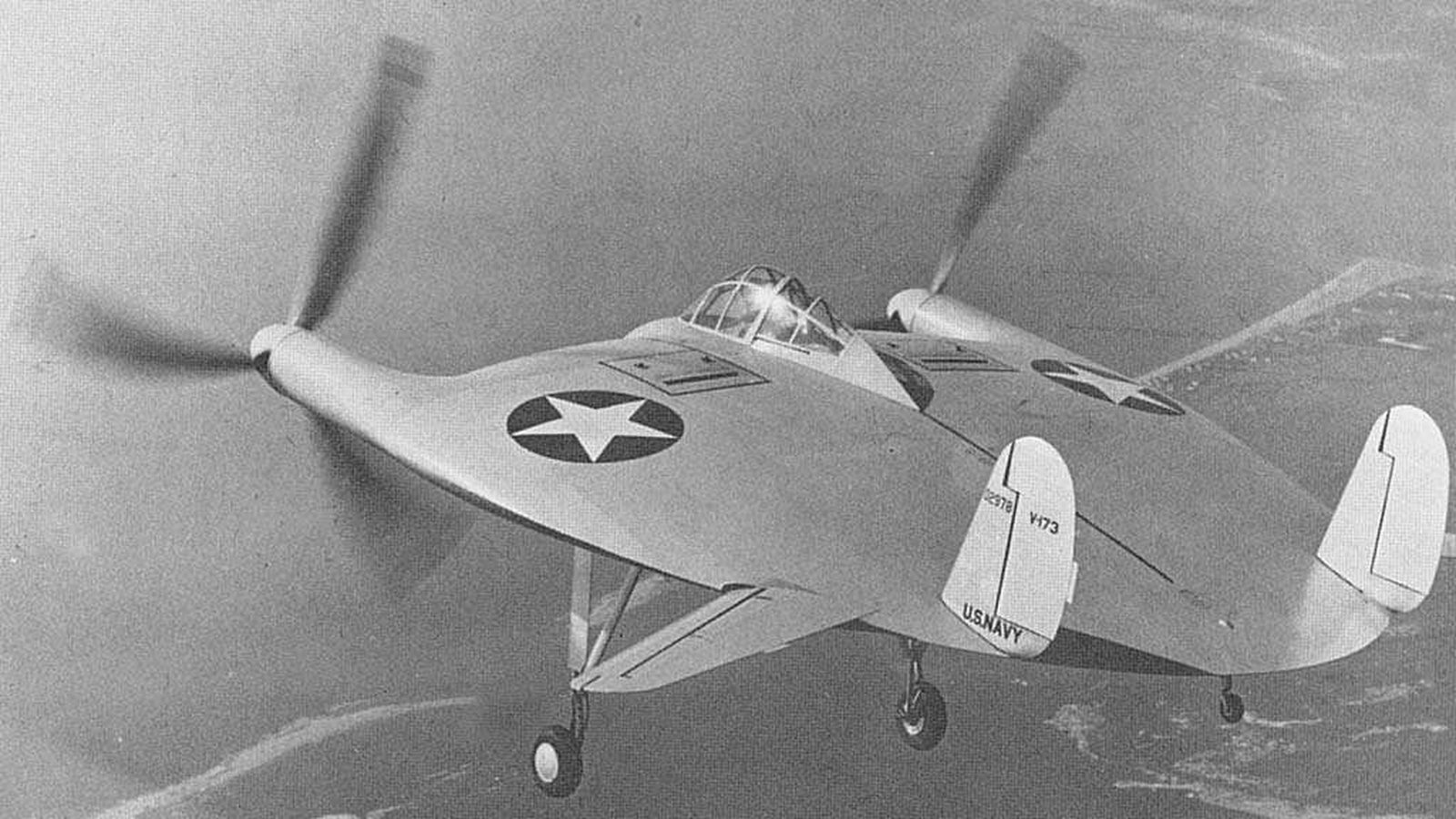
Breakfast with propellers
If you squint at a regular airplane, you see a long body and skinny wings. Squint at the Vought V-173 and you see a dinner plate that learned to fly.
It was a flat disk, about 23.3 to 23.4 feet across, with 427 square feet of wing. A lot of lifting surface for a little ship. Two 80 horsepower Continental A-80 engines hid inside the disk and drove huge propellers at the wingtips — later, three-bladed props 16 feet 6 inches long. Wood and canvas. A proof-of-concept machine, not a combat plane.
The nose sat 22 degrees high on tall gear, so on the ground it looked about to take a bow. The pilot sat so nose-high for landing that he had to look past his feet. They put windows in the belly. The windows did not help much.
Wingman, six, says it looks like a dinner plate that grew arms and decided to mow the lawn.
Designer Charles H. Zimmerman wanted a plane that could take off and land very slowly — the trick you need for short Navy decks. Vought’s chief test pilot, Boone Guyton, flew it first on 23 November 1942. Last flight: 31 March 1947. In between: 190 flights and 131.8 hours in the air.
Fight the little tornados
Wings leak. Air under high pressure slops around the tip and rolls into a vortex, a tiny tornado that steals lift and adds drag. Zimmerman parked giant propellers right at those tips so the spinning air would fight the vortices. The disk was so stubby and so full of wing that it almost would not stall. Stall is when a wing quits because the air peels off. Almost-won’t-stall is a superpower if you are crawling onto a short deck.
The pancake was not fast. Max speed about 138 mph. Climb to 5,000 feet in 7 minutes. Gross weight 2,258 pounds, about a very small car. Slow and floaty was the point. Speed was someone else’s job.
Gearbox vibration delayed the first flight. Huge props, modest engines, gears in between that had to behave. They eventually did.
Charles Lindbergh flew it and found it easy and impressive at low speed.
The UFO, and the beach
People in Connecticut reported UFOs when they saw it. Fair. If a dinner-plate airplane with two giant fans drifted over your town, you would not think “test ship.” You would think about sitting down.
There was an emergency beach landing. Two bathers were in the path. The pilot locked the brakes. The plane flipped onto its back. The airframe was so strong that neither the plane nor the pilot was badly hurt.
A bigger metal fighter version, the XF5U-1 “Flying Flapjack,” got built. It only did runway hops. Never a true flight. The wooden V-173 is the ship that actually lived in the air.
Why a flying plate still matters
The V-173 showed that a wide, round wing plus tip props could stay flying at speeds that would dump an ordinary airplane on its nose. It also showed the cost: gearboxes that shook, a view that was basically your shoes, and a shape so odd that neighbors filed sky-object reports.
Almost hovering is not hovering. Helicopters beat air downward on purpose. The pancake still needed a runway and forward speed. The gap Zimmerman hunted was between “needs a huge field” and “might work on a short deck.”
The airplane was restored. It is on loan from the Smithsonian to the Frontiers of Flight Museum in Dallas, Texas. You can look at a real disk that flew 190 times. Notice how little airplane body there is and how much wing. That is the whole argument, sitting where you can walk around it.
Try this: the towel carrier
Fold a round, wide paper plane — or fold the Cloud Glider from this site, the slow floaty one. Do not throw it hard. Let it loaf.
Now make a “carrier.” Lay a bath towel on the floor. That is your deck. Stand three big steps back. Launch so the glider lands on the towel and stays there. If it skids off, the landing was too hot. If it mush-stalls short, you got slow but missed the boat.
Captain keeps score. Co-Pilot cheats by walking closer. Wingman throws from the couch, which is not a Navy rule we can find.
Short-deck flying is a feeling in your hands: more wing, less hurry, a landing that looks almost like hovering until the wheels kiss.
Source note
Smithsonian / Frontiers of Flight Museum (Vought V-173 on loan in Dallas); Vought flight-test record (190 flights, 131.8 hours).
Crew note
Captain measured our biggest paper disk against a real dinner plate and declared Zimmerman close enough. Co-Pilot wants belly windows on the next glider, even after we told him they did not help. Wingman still calls it the pancake, and he is right — that is the honest name.