The Plane That Was a Tube
In 1932 Italy built a wooden airplane whose whole body was a hollow barrel, with the engine and propeller spinning inside like a secret.
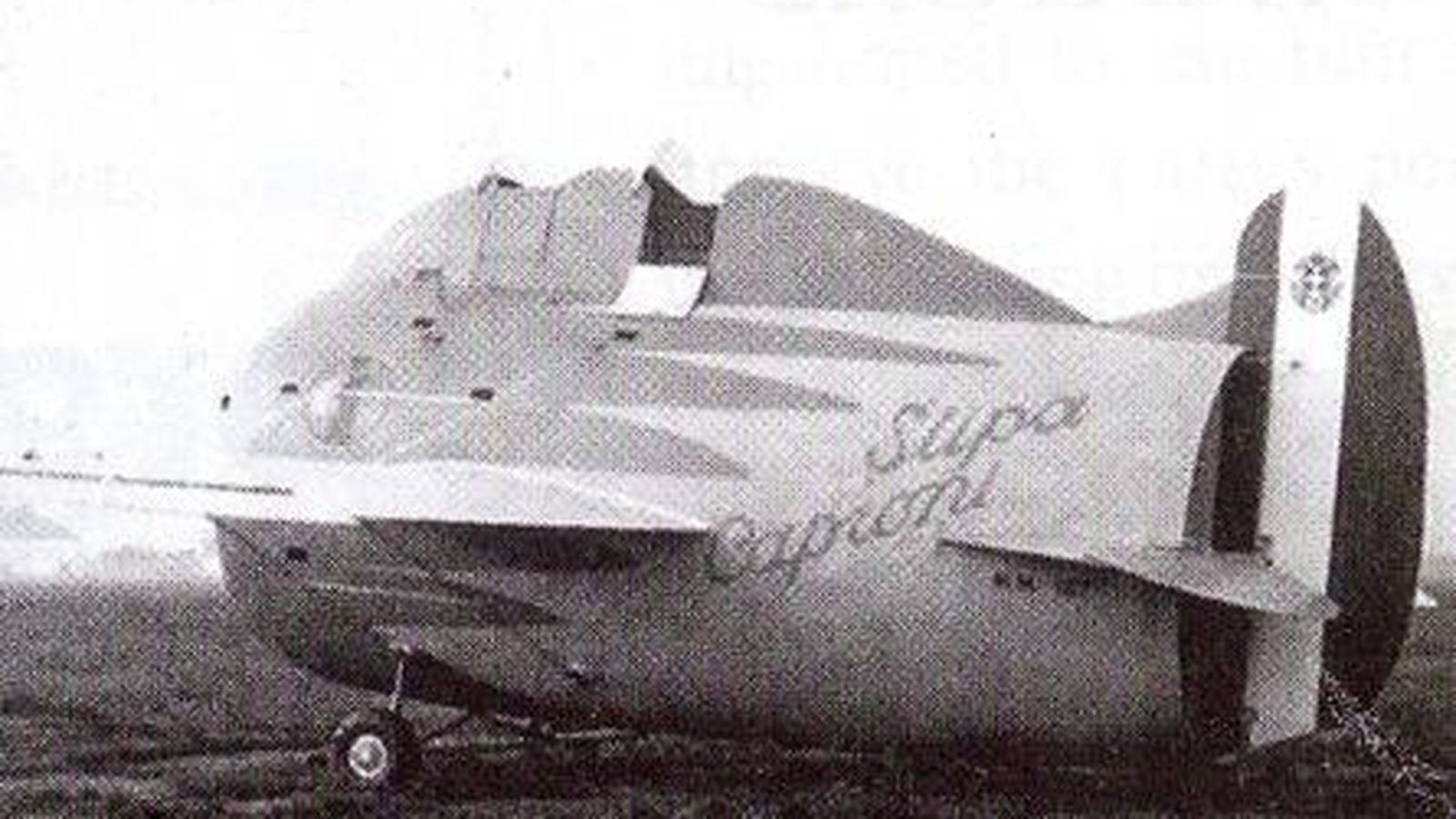
A barrel with wings
Most planes have a skinny nose and a propeller out front. This one did not. Picture a giant wooden tube, tapered like a funnel, hanging under elliptical wings. The engine sat inside the tube. The propeller spun inside the tube. Two open cockpits perched in a hump on top, so the crew could see over the rim.
Wingman says it looks like someone glued wings on a rain barrel and dared it to fly.
The real name was the Stipa-Caproni. People called it the flying barrel. Designer Luigi Stipa (1900–1992) named his idea an “intubed propeller.” Caproni built it in Italy in 1932. Test pilot Domenico Antonini first flew it on 7 October 1932.
They painted it light blue and cream, like racers. The rudder wore the Italian flag. It looked swift sitting still. That part was a trick.
Stuff the propeller in a funnel
Stipa was chasing air, not a flying gag.
A propeller bites air and throws it backward. That shove is what makes a plane go. His question: what if the whole propeller sat in a carefully shaped tube? The tube would act like a venturi — a tapered tunnel that speeds air as it squeezes through. The fuselage was the cowling. The fuselage was the duct. Nothing extra hanging out except the wings and that cockpit hump.
The engine was a 120 horsepower de Havilland Gipsy III. Modest. The airframe was a wooden mid-wing monoplane. Small rudder and elevators sat on the back of the tube, right in the prop wash, so moving air kept the controls honest even when the plane was slow.
Stipa did not want this one-engine barrel as the final airplane. He meant the idea for bigger, multi-engine flying wings. This wooden ship was a testbed. One plane. One shot at proving the tube.
Quiet, slow, and stubborn
It flew.
It was quieter than the usual open-prop trainers. It landed at only 68 km/h — 42 mph. Takeoff and landing runs were around 180 meters.
The trouble showed up when they asked it to hurry. Top speed was only 131 to 133 km/h (81 to 83 mph). The fat tube added so much drag that it ate the extra shove the venturi was supposed to give. Captain, ten, keeps score of everything. He put it this way: the tube helped the air, then the outside of the tube charged a tax.
It was extremely stable. Almost too stable. Changing course felt like turning a barge. Fine for a calm ride. Bad if you need to dart.
The Italian air force cancelled further development. Only one Stipa-Caproni was ever built.
Why a flying drainpipe still matters
A one-off airplane is not a failed idea. It is a data point with wings.
The United States NACA — later NASA — published Stipa’s work as Technical Memorandum 753, so engineers could read the numbers instead of guessing. Some historians later called it a predecessor of today’s turbofan, the engine-in-a-tube idea. It is not a jet. The Gipsy III was a piston engine turning a propeller. The shape of the thought stuck: put the spinning bit in a duct and manage the air.
Years later, in Australia, Lynette Zuccoli and Aerotec Queensland built a three-fifths-scale replica. In October 2001, Bryce Wolff made two short hops — about 600 meters long, about 6 meters high. The replica now sits on static display at Toowoomba City Aerodrome. You can walk up and stare down the tube.
Co-Pilot asked if you could crawl through. We told him no, and also that he would get stuck, and also that museums hate that.
Try this: fold the tube
This site already has a paper design called The Hover Ring. The tagline is the lesson: “it’s not a plane, it’s a tube — and it flies.”
Fold one. Do not skip the ring. Throw it gently, like you are handing it to the air. Watch the hollow middle carry the spin. Then fold a dart and throw both down the same hallway. The dart is a spear. The ring is a barrel. Different jobs.
If you have a wrapping-paper tube, blow through it, then blow past it. Feel how the tube grabs the puff and aims it. That is the cheap venturi. Paint your Hover Ring light blue and cream if you want. Try a short landing on a rug. Speed was never the prize.
Source note
NACA Technical Memorandum 753 (Stipa’s intubed-propeller work); replica hops recorded at Toowoomba City Aerodrome.
Crew note
Captain keeps drawing the barrel in side view so you can see the propeller hiding in the dark. Co-Pilot still thinks the hump cockpits look like a camel got hired as a fuselage. Wingman asked if we could paint our Hover Ring light blue and cream, and we said yes — that is the point of a paper plane: you get one more try.