The Jet That Landed Itself
On 2 February 1970 a U.S. Air Force F-106 entered a flat spin. The pilot punched out. The empty jet recovered, flew on, and parked itself in a snowy Montana field.
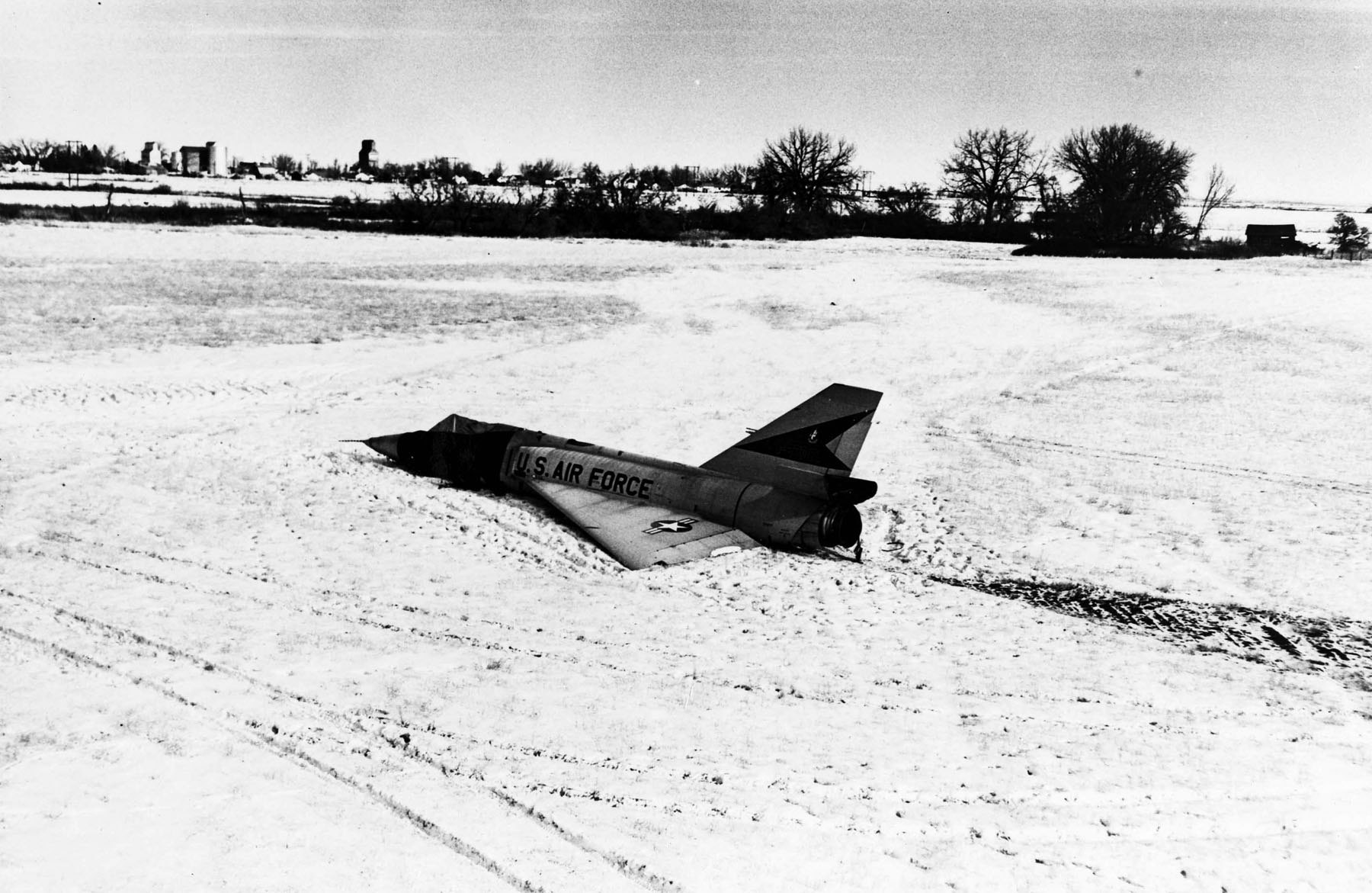
Empty seat, still flying
Most airplanes need a person in the seat. This one finished the landing without one.
The airplane was a Convair F-106A Delta Dart, serial 58-0787. Delta wing. One engine. Built as a fast interceptor, not a bomber. People still call it the Cornfield Bomber, because the field it chose looked like farm country in winter, and because the nickname is too good to drop.
On 2 February 1970 it belonged to the 71st Fighter-Interceptor Squadron at Malmstrom Air Force Base, next to Great Falls, Montana. First Lieutenant Gary Foust was flying a training flight with other jets. The F-106 entered a flat spin. A flat spin is the ugly kind: the nose stays high, the airplane rotates like a plate on a table, and the controls stop meaning what they usually mean.
Foust tried the drag chute. It did not break the spin. He ejected at about 15,000 feet. He survived. That is the first honest line of this story.
The airplane changed its mind
When the seat left, the airplane got lighter in a hurry. The blast from the ejection shoved the nose down. Foust had already trimmed the jet as if for takeoff, with the throttle at idle. Those three changes — less weight, a nose shove, and that trim — pulled it out of the spin.
One of the other pilots radioed Foust while he hung under his parachute: you’d better get back in it.
From the silk, Foust watched his own jet fly away, wings level, and slide to a stop in a snow-covered field near Big Sandy, Montana. Locals on snowmobiles found Foust in the nearby mountains. The jet sat in the field, still an airplane, not a hole in the ground.
They hauled 58-0787 out. They repaired it. It went back on the schedule with the 49th Fighter-Interceptor Squadron, the last Air Force unit to fly the F-106. In 1979, while training at Tyndall Air Force Base, Foust flew that same tail number again. Same jet. Same person. Different day.
In August 1986 the Air Force gave it to the National Museum of the U.S. Air Force in Dayton, Ohio. You can walk up to it. It is not a replica of a legend. It is the legend, washed and parked.
Why an empty landing still matters
The F-106 did not “decide” anything. Airplanes do not have moods. They have mass, trim, and air.
Take the pilot out and you change the balance. Change the balance in a spin and you might get a miracle, or you might get a wreck. This time the numbers lined up. That is not a plan you can sell. It is a reminder that the air is doing physics whether anyone is holding the stick.
Captain, ten, wrote the date on the hangar board twice so nobody rounds it: 2 February 1970. Co-Pilot, eight, wants to know if the farmer charged rent. Wingman, six, named it the snow jet, which is closer to the photo than “bomber” ever was.
Try this: the empty landing
Fold a paper dart. Do not throw it at a person. Throw it at a towel on the floor.
Now fold a second dart and tape a paper-clip “pilot” on the nose. Throw both from the same spot. The heavy-nose dart and the empty dart will not land in the same place. That is a tiny version of what the F-106 did when the seat left.
Do not try this with a real airplane. The hangar already has a museum for that.
Source note
U.S. Air Force / National Museum of the U.S. Air Force (F-106A 58-0787); incident 2 Feb 1970 near Big Sandy, Montana; pilot 1st Lt. Gary Foust survived; aircraft repaired and later flown by Foust again in 1979; museum accession August 1986.