The Fighter That Sat on Its Tail
Convair built a Navy jet that parked pointing at the sky, took off like a bottle rocket, then asked the pilot to land by looking over his shoulder.
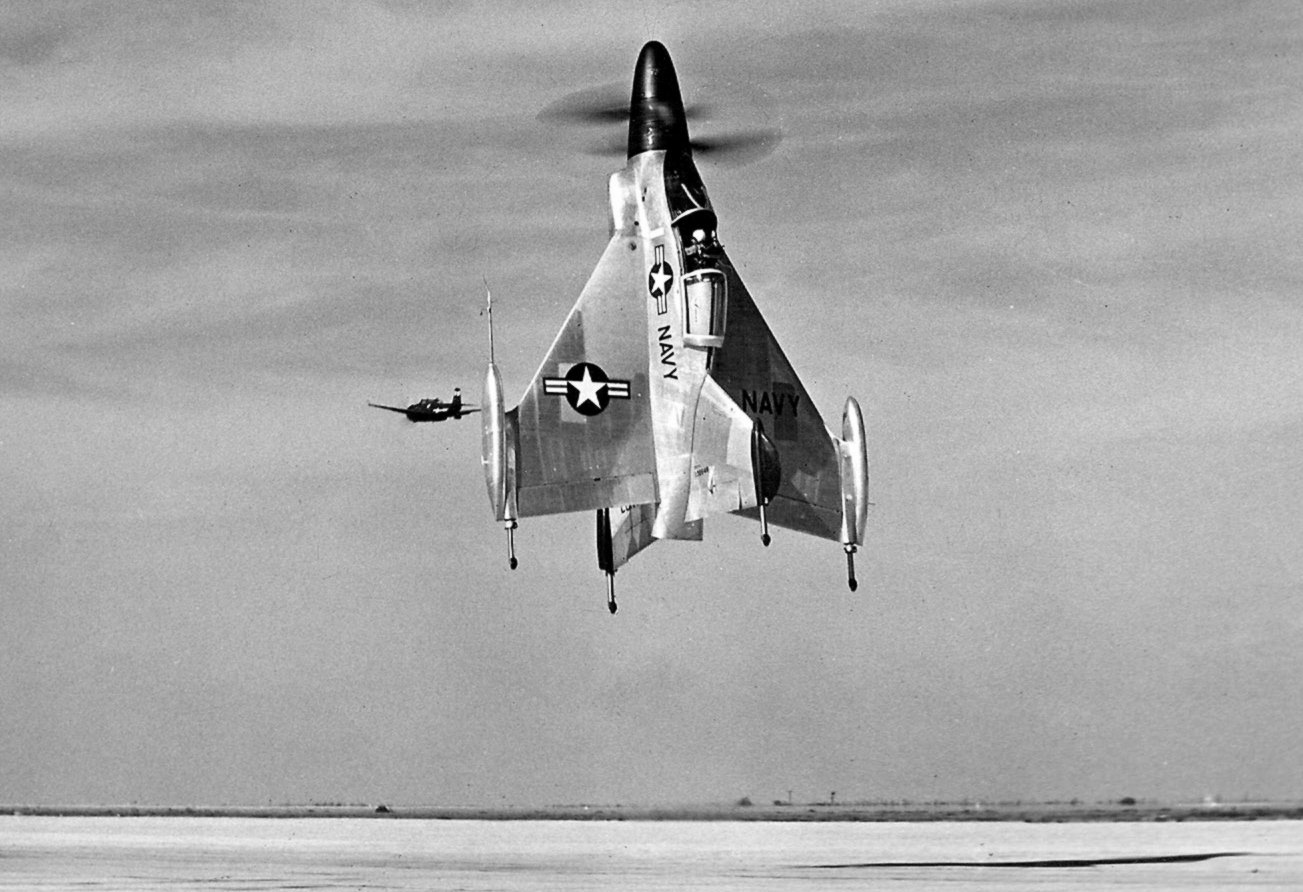
A pogo stick with a cockpit
Airplanes usually sit on their bellies. This one sat on its tail, nose to the clouds, like it was waiting to be launched.
Convair called it the XFY-1. The Navy called it the Pogo, after the toy that bounces on a spring. Serial of the one that actually flew: BuNo 138649. Lockheed built a cousin, the XFV. Each company got one flying machine, not two.
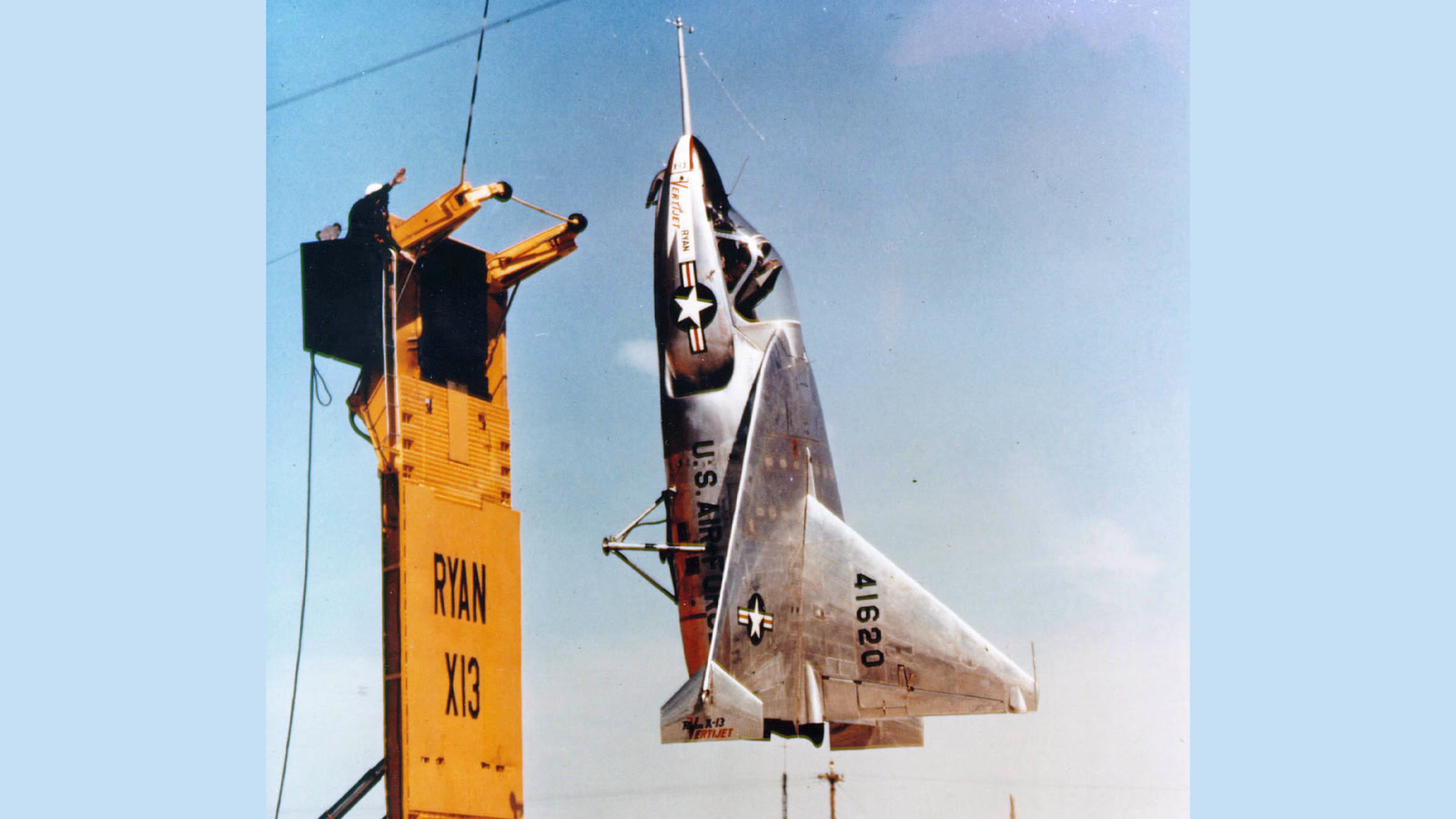
The idea was not a toy. After the 1940s, the Navy wanted a fast airplane that could live on an ordinary ship — not only on a giant aircraft carrier with a long deck. Helicopters could rise straight up. They could not sprint. The Pogo was supposed to do both: stand on a small patch of steel, climb, then fly like a fighter.
It had a delta wing swept 52 degrees, plus big fins, so from the front it looked like a plus sign. At each of the four tips sat a little caster wheel. That is how a tail-sitter parks. The propeller was not one disc. It was two, stacked, spinning opposite ways — contra-rotating — about 16 feet across, driven by an Allison T40 turboprop. The seat hung on gimbals so the pilot could tilt from looking up (vertical) to looking forward (cruise).
Wingman, six, says it looks like a dart that refused to lie down. He is not wrong.
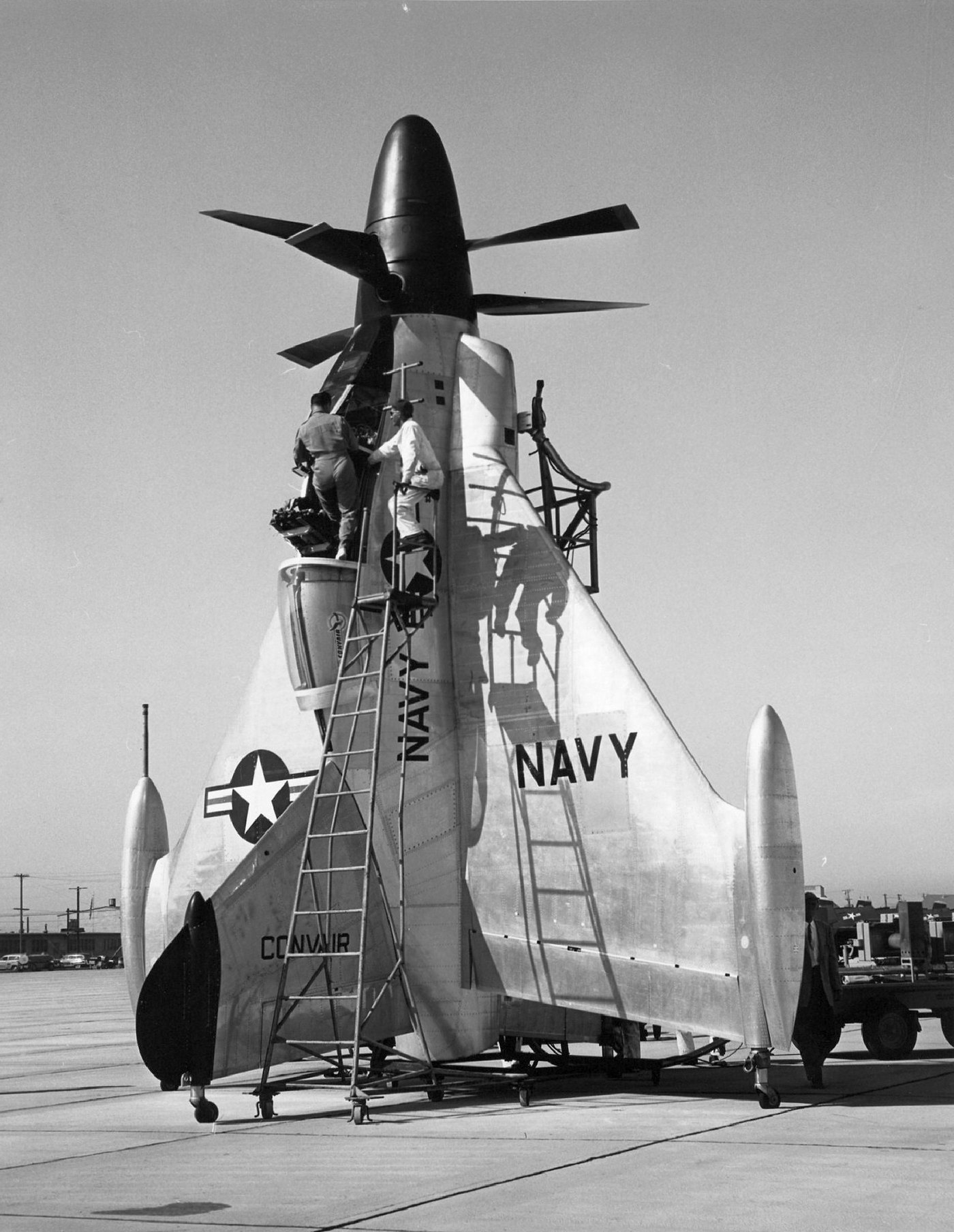
Tethers, then the real sky
First tethered hover: 19 April 1954, inside a giant airship hangar at Moffett Field, California. The test pilot was James F. “Skeets” Coleman, a Marine reservist and Convair engineer-pilot. They took the spinner off the prop hub and ran safety lines. Another engineer, Bob McGreary, held a winch. If Coleman lost it, the hangar could catch the airplane. Four more cables on the wings. That is how you invent a new kind of takeoff without inventing a crater.
Coleman logged about 60 hours on the tethers. Then they went outside.
First free flight: 1 August 1954. Later that year, at Naval Auxiliary Air Station Brown Field, he flew about 70 takeoff-and-landing drills. First time he tilted from pointing up to flying across the sky: 5 November 1954. Some logs argue 2 November or 4 November. Captain keeps 5 November and a pencil note that honest books disagree.
The hard part was not going up. The hard part was coming down. To land, the Pogo had to stand on its tail again, sink slowly, and kiss four tiny wheels to the ground. The pilot had to look over his shoulder to see the earth. No speed brakes worth mentioning. A light airplane that did not want to stop. Jets of that same decade were already chasing Mach 2. The Pogo was a propeller ship. Fast for a propeller. Late for a fighter.
They tried again on 19 May 1955. It did not save the program. Formally wrapped: 1 August 1955. Last flight: November 1956.
Only a very sharp pilot could land it. That killed the dream of parking one on every ship. You cannot staff a whole navy with Skeets Colemans.
Why a tail-sitter still matters
Harriers and Ospreys later proved you can rise without a carrier deck. They did it with jet lift, or tilt-rotors, and with a lot more years of work. The Pogo was the loud first draft: point the whole airplane at the sky and hope the landing is a conversation with your neck.
You can still see 138649. After a stretch on static display at Naval Air Station Norfolk, it went to the Smithsonian’s National Air and Space Museum. The shape is the argument. Four little wheels. A seat that tilts. A propeller the size of a room.
Try this: the over-the-shoulder landing
Stand a paper dart on its tail against a book so it points at the ceiling. That is parked.
Now pick it up high, look over your shoulder at a towel on the floor, and lower it slowly until the tail touches. Do not look at the dart. Look at the towel. If it tips, you just met the Pogo’s actual job.
Co-Pilot cheats by watching the dart. Captain scores only the landings done with a turned head. Wingman lowers his from the sofa, which is not a Navy deck we can find.
Source note
U.S. Navy / Smithsonian National Air and Space Museum (Convair XFY-1 BuNo 138649); tethered first flight 19 Apr 1954 at Moffett Field; first free flight 1 Aug 1954; first conversion to horizontal flight 5 Nov 1954 (dates in sources also include 2 and 4 Nov); last flight Nov 1956.