The Plane That Skimmed Like a Skimming Stone
Spies named it the Caspian Sea Monster. It was not a sea monster. It was a 92-meter flying boat that never really left the water.
Neither a plane nor a ship. Both.
Most planes climb into the sky. Most ships stay in the water. This one cheated.
It ran on ten jet engines. It had stubby wings. It weighed as much as a small office building. Then it flew — but only a few meters up, right where the air gets fat over the sea.
People later called the idea an ekranoplan. The Russian word is a mouthful. Captain, ten, translates it as “screen plane.” The screen is the water. The plane uses the cushion of air trapped between its wings and that screen. Stay low and the cushion holds you up. Climb out of it and you are just a fat airplane with tiny wings, and tiny wings are a bad plan.
Wingman, six, says it is a paper plane that refuses to leave the table.
Ground effect, the cheap trick
Hold your hand flat, palm down, and swoop it over a table. Close. Not touching. You can feel a little bounce. That bounce is ground effect.
Air under a wing has to squeeze out the sides. Near a surface, it cannot escape as fast. Pressure builds. Lift gets a bonus. Birds use it when they skim. Seaplanes use it on takeoff. Rostislav Alexeyev, a Soviet hydrofoil designer, decided to build a whole machine that never left that bonus.
The first giant was named KM. In Russian that meant “model ship.” It was 92 meters long — about 302 feet. Wingspan 37.6 meters. Maximum takeoff weight 544 tonnes. Ten Dobrynin VD-7 turbojets: eight clustered behind the cockpit to shove air under the wings at takeoff, two on the tail to keep it going. Cruise about 430 km/h (267 mph). Design height over the water: 4 to 14 meters. A bottle of champagne got smashed on the nose, like a ship, because the paperwork said it was a boat.
They built it in Gorky, now Nizhny Novgorod. On 22 June 1966 they hid it under camouflage and moved it at night down the Volga River to Kaspiysk on the Caspian Sea. First flight: 16 October 1966. Pilots: Vladimir Loginov and Alexeyev himself. Soviet designers almost never flew their own machines. He did.
The monster on the spy photo
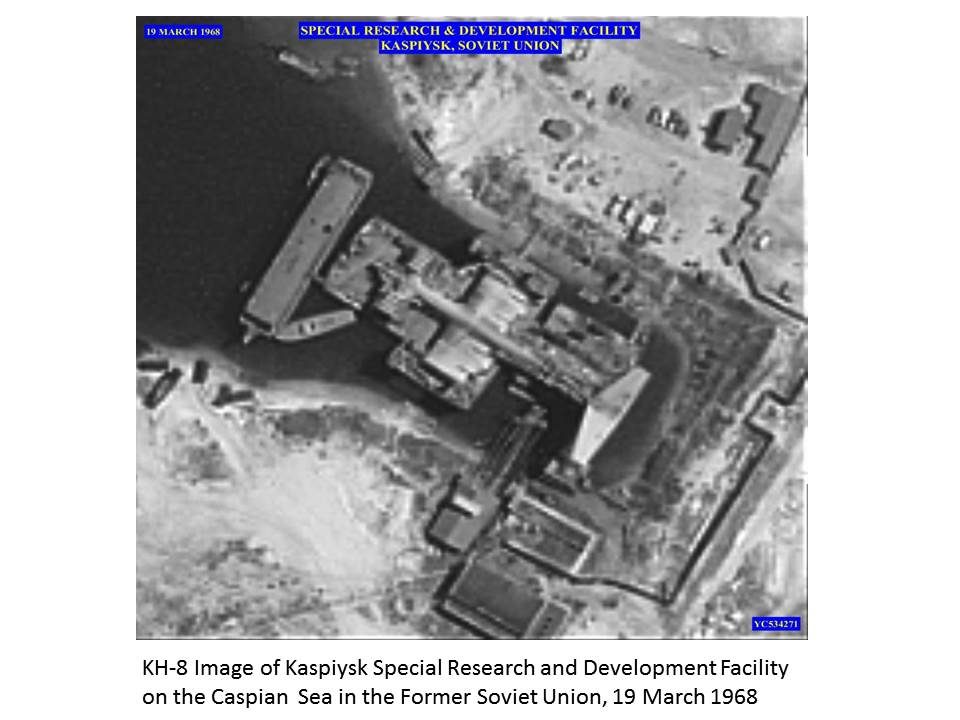
American satellites spotted it. The shape did not match any airplane they knew. Stub wings. Boat hull. A city of engines on the nose. They nicknamed it the Caspian Sea Monster.
A KH-8 spy satellite photographed the dock at Kaspiysk on 19 March 1968. That picture is public now. You can see the long body, the eight engines up front, and the huge T-tail. It looks like someone parked a whale with wings.
The KM stayed the heaviest aircraft in the world for fifteen years. It was not a passenger liner. It was a testbed. Alexeyev wanted rescue boats and fast navy craft that could ignore waves the way a stone ignores a puddle.
Waves still won some arguments. The KM liked calm water. In 1980 a pilot error put it into the Caspian. Nobody died. The machine was too heavy to salvage. It sank about a week later and is still down there. They did not build a second KM.
The cousin on the beach
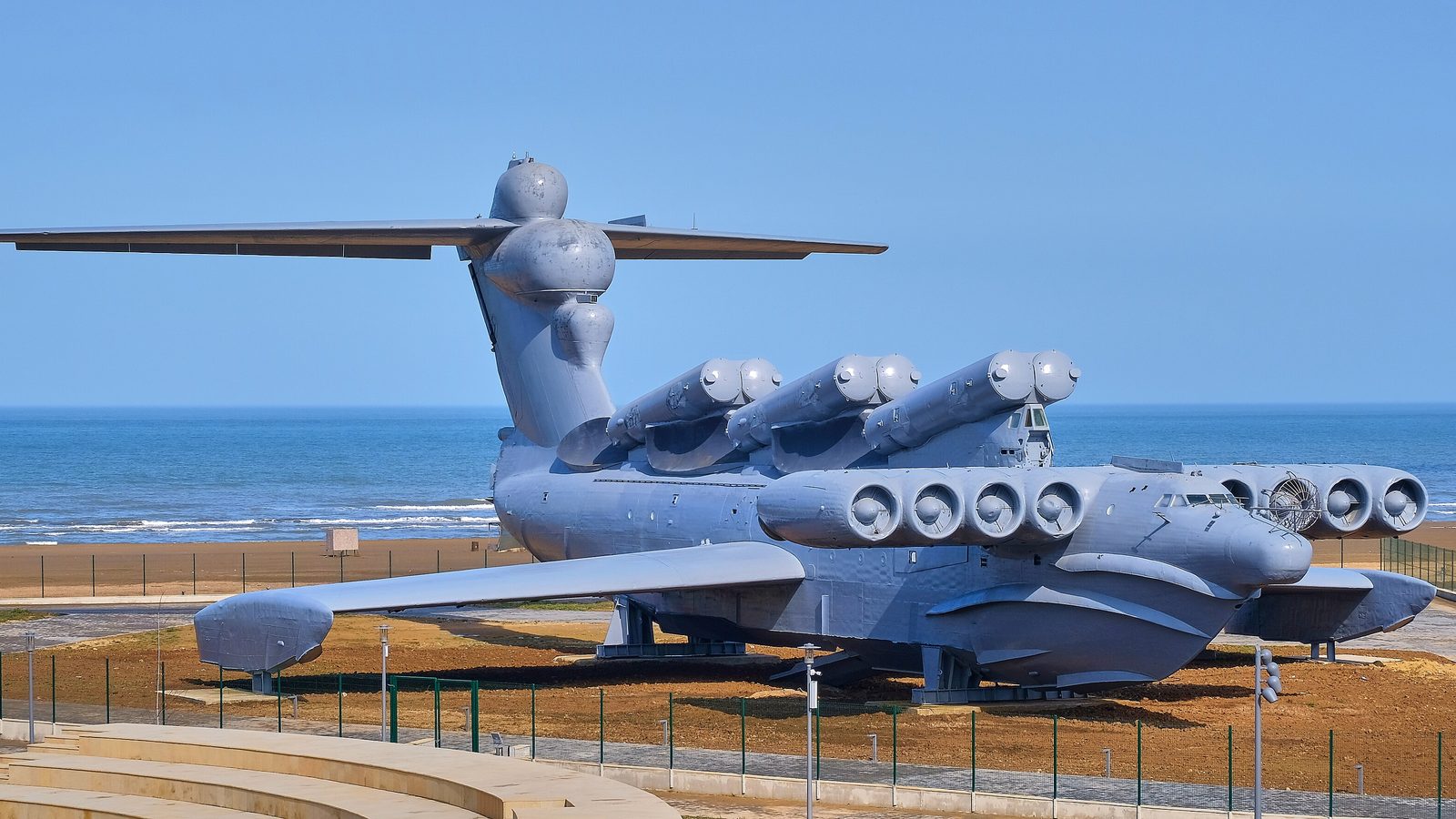
The later cousin was the Lun. Same family. Same low skim. One of them, MD-160, actually entered navy service. Then it sat for years. Then people dragged it onto a beach in Dagestan, at a park called Patriot.
You can walk up to it. Short fat wings. Boat hull. A stack of jet intakes behind the cockpit, fans visible in the tubes. A giant T-tail. It looks like a gray shark that crawled ashore and decided to stay. Co-Pilot, eight, wanted to know if the tubes on its back were for carrying extra snacks. They are not snacks. They are leftover navy hardware. The interesting part is still the skim.
Try this: the table-skim
Fold a dart. Throw it down a hallway at chest height. Time how far it goes.
Now throw the same dart so it starts just above a long table or a smooth floor. Keep the throw gentle. If the nose stays level, it should float farther, like it found an invisible rug.
That rug is ground effect. The KM lived on it. The Lun lived on it. Your dart can borrow it for a second.
Do not aim at anyone. Do not skim a dart at a dog. If the dart dives, the nose was too heavy. Add a tiny bit of up-elevator — a small upward fold on the back of the wing — and try again.
Source note
KM facts from Komissarov, Russia’s Ekranoplans, and Gunston, The Osprey Encyclopedia of Russian Aircraft 1875–1995. Satellite photo: U.S. National Reconnaissance Office KH-8 image of Kaspiysk, 19 March 1968 (public domain). Lun photo: Vyacheslav Bukharov, Wikimedia Commons, CC BY-SA 4.0.
Crew note
Captain measured the hallway and declared it “one-fiftieth of a Caspian.” Co-Pilot keeps calling it a flying ferry. Wingman tried the table-skim and then asked if we could paint the dart gray. We said yes. Gray darts still have to miss the lamp.