The Nine-Wing Flying Boat That Tried to Be an Ocean Liner
In 1921 Italy launched a nine-wing flying boat meant to carry 100 people across an ocean. It hopped twice over a lake. The second hop ended in a stall.
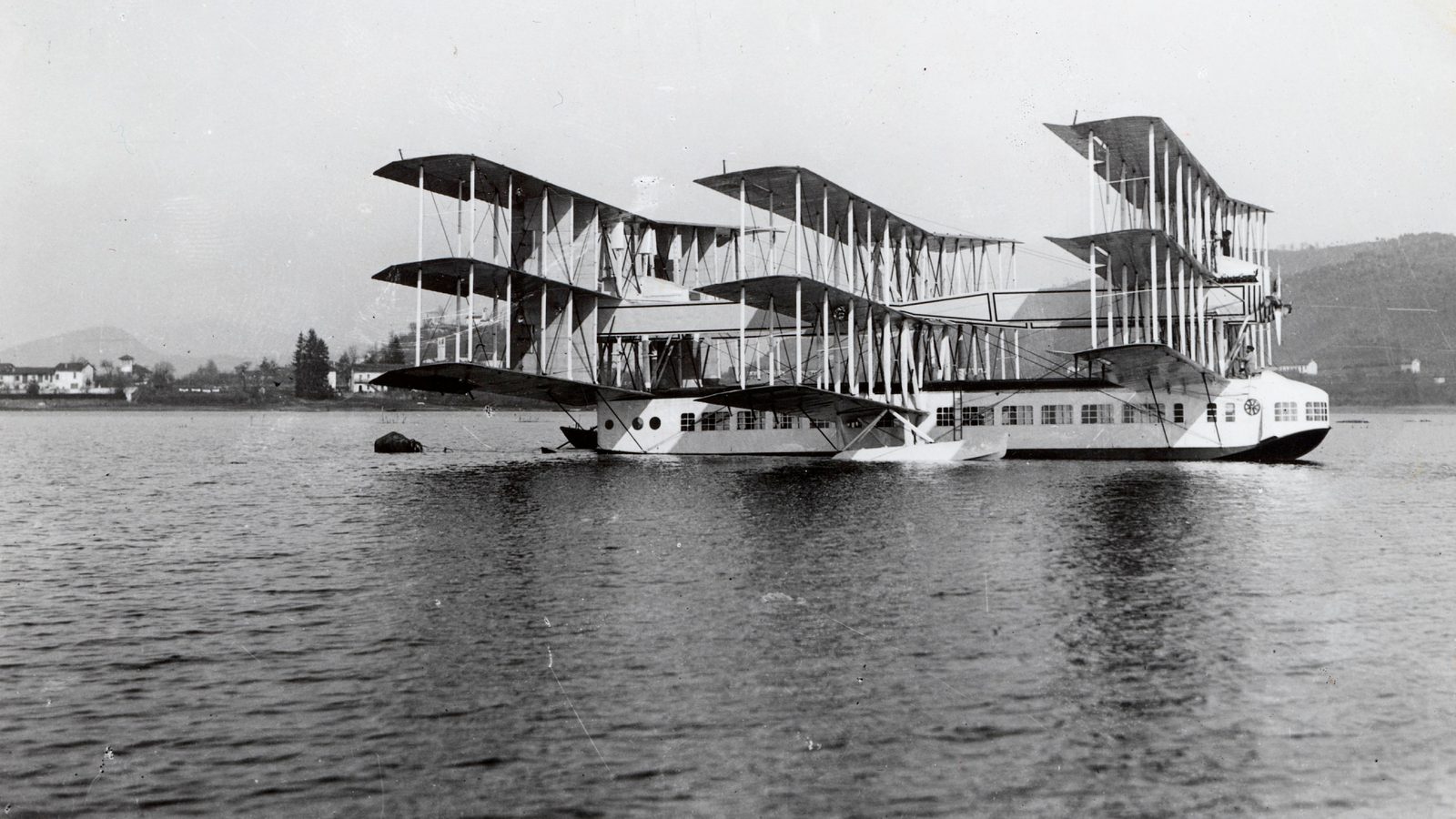
Nine wings, one lake
Most flying boats have one wing set and a hull that sits on water. This one looked like someone stacked three triplanes in a row on a hull.
Three triplane sets. Nine wings. The names were Transaereo and Noviplano. In the shop it started as model “3000.” Ca.60 was the later catalog name. Gianni Caproni built it at Sesto Calende, on Lake Maggiore, Italy. It was a prototype for a 100-passenger flying boat — an ocean liner that would take off from water.
Eight Liberty L-12 engines, about 400 horsepower each. Wings reused from leftover Caproni Ca.4 bombers. Floats by Alessandro Guidoni. A giant hangar went up in 1920. The patent is dated 6 February 1919. Construction began in the second half of 1919.
Wingman counted the wings three times and got nine every time, which annoyed him.
No conventional tail. Pitch came from the front set of ailerons working against the rear set. Yaw came from four rudders on the rear wings. Two flight engineers sat in open nacelle cockpits. Two pilots sat open-air above the cabin. Test pilot Federico Semprini flew every trial alone.
An ocean liner that had to float first
The plan was passengers. Crew of eight, 100 passengers on the sheet. Common numbers: length 22.6 meters, span 30.5 meters, height 9.63 meters, wing area 750 square meters. Empty weight 14,000 kilograms. Max takeoff 26,000 kilograms. Cruise 130 km/h. Range 610 kilometers.
Why nine wings? More wing means more lift at modest speed. Caproni was trying to lift a boatload of people without a huge runway. Water was the runway. The hull was the airport.
The cost of stacking wings is drag, weight, and a ship that does not pitch like a normal airplane. Front wings and rear wings can argue with each other.
Two hops, then the stall
First water taxi: 9 February 1921. Too light in the bow. They added ballast.
The first-flight date is a fight among historians. Some say 12 February 1921. Some say 2 March 1921. We are not picking. It was a brief hop at about 80 km/h.
Second flight: 4 March 1921. Semprini later recalled 100 to 110 km/h, a sharp nose-up, then a stall, then the tail hit the lake first. The front third of the machine shattered. Semprini and both flight engineers got out unhurt. Caproni arrived late and missed the crash.
He is documented as saying: “So the fruit of years of work, an aircraft that was to form the basis of future aviation, all is lost in a moment. But one must not be shocked if one wants to progress. The path of progress is strewn with suffering.”
The nose got too high. The wings ran out of speed. Stall. Theories about why the nose went up — flag these as theories, not a verdict — include a steamboat wake, missing a ferry, and unsecured sandbags sliding aft.
Captain, ten, wanted a score. Two flights. One taxi that taught them the bow was light. Zero ocean crossings.
Why a wrecked flying boat still matters
The Ca.60 is an early try at an airliner that did not need a giant field. Water looked free. Passengers looked possible. Nine wings looked like enough lift.
It also showed how a tandem wing can bite. Get nose-high, lose speed, and a flying boat becomes a hull that arrived wrong. Caproni’s own sentence is the grown-up lesson: you can lose the machine and still keep the work of trying.
Pieces survive. Museo Caproni in Trento has outriggers, the lower front hull, a control panel, and one Liberty engine. Volandia at Vizzola Ticino has a truss-boom and a hydrofoil. Hayao Miyazaki’s film The Wind Rises (2013) puts the Ca.60 into dream sequences. That is a film dream, not a documentary.
Try this: the mini noviplano
Fold a normal dart. Throw it down a hallway. That is one wing set, one personality.
Now make a mini noviplano. Cut or fold three small wing sets — each can be a short paper strip with a little up-fold at the tips. Tape them in a row along a straw or a rolled paper hull: front, middle, rear. Keep the rear one able to bend a bit, like those rear ailerons.
Throw both. The dart goes where you expect. The tandem one pitches strangely. If the nose is high and the throw is slow, it will mush and drop — a hallway stall, no lake required.
Source note
Caproni Ca.60 record (patent 6 Feb 1919; water taxi 9 Feb 1921; first-flight date disputed 12 Feb vs 2 Mar 1921; second flight and stall 4 Mar 1921); Museo Caproni, Trento; Volandia, Vizzola Ticino.
Crew note
Captain drew three triplane stacks on the whiteboard and labeled them front, middle, rear, then refused to draw a tail. Co-Pilot wants to watch The Wind Rises and we said yes, as long as he remembers the lake scenes are a dream. Wingman still counts the wings out loud, and nine is the right answer every time.