The Plane That Wanted to Hover, Skim, and Fly High
Robert Bartini’s VVA-14 was a Soviet amphibian with three jobs: rise straight up, cruise like an airplane, and skim the sea on a cushion of air. The hover engines never arrived. The survivor still sits at Monino.
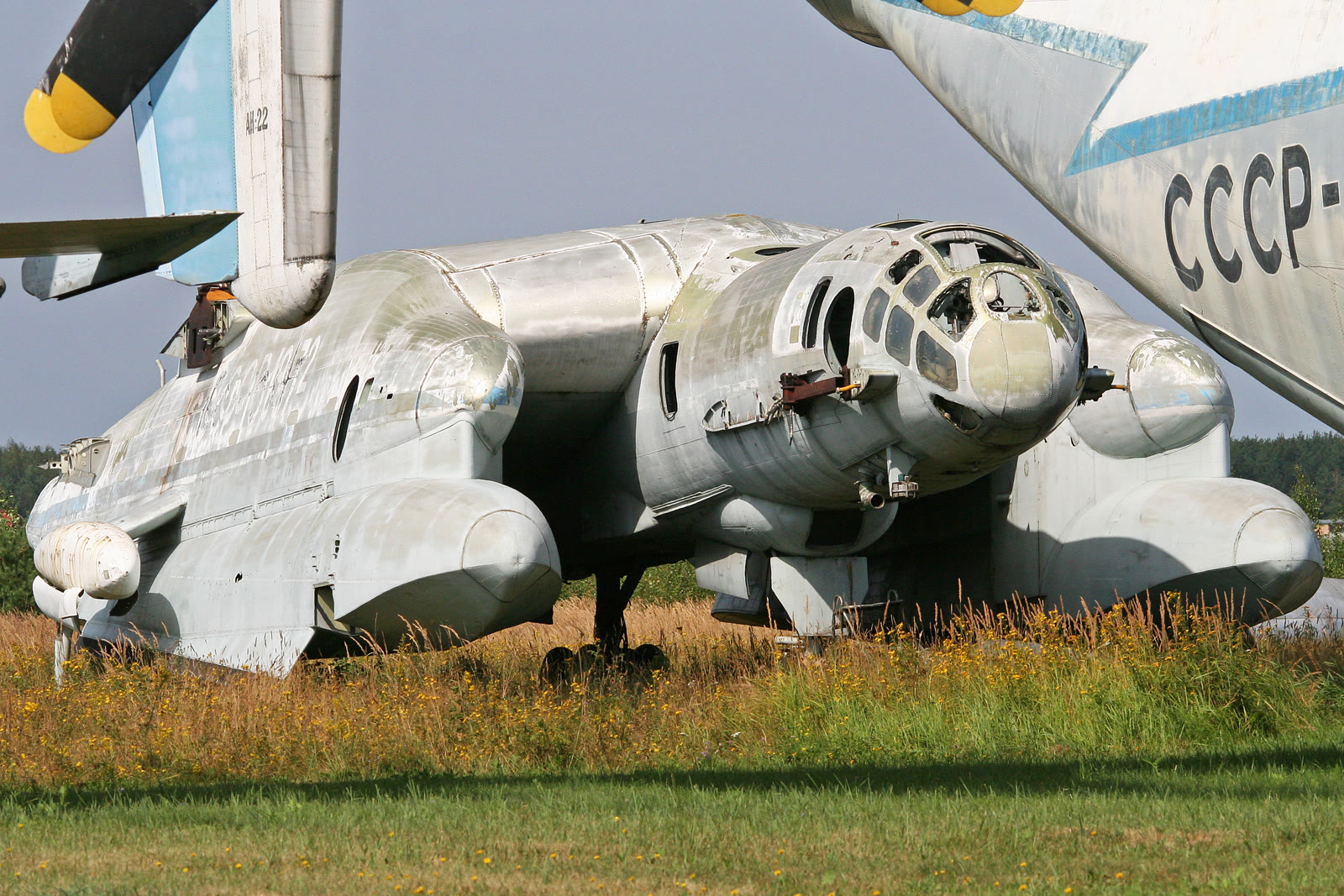
Three jobs. One odd amphibian.
Most airplanes pick a lane. Some roll down a runway. Some float. A few skim. The Bartini-Beriev VVA-14 wanted all of it.
The letters stand for a Russian mouthful: Vertikalno-Vzletayushchaya Amfibiya — vertical-takeoff amphibian. Designer Robert Bartini sketched the idea. The Beriev flying-boat shop in Taganrog helped build it. On paper it would rise straight up, cruise like a normal airplane high over the weather, and also ride the fat cushion of air just above the sea. That last trick is ground effect — the same bounce the hangar already met on the Caspian Sea Monster. This machine was not that machine. The Lun and the KM stayed low on purpose. The VVA-14 was supposed to leave the cushion, climb, and come back.
Wingman, six, called it the triple plane. Captain Jacob, ten, wrote three verbs on the board: hover, skim, fly. Then he underlined wanted.
The job on the sheet was ocean search. In the Polaris years, designers worried about boats that hid under water and carried long-range missiles. Bartini’s answer was a search plane that could wait on a coast, jump up without a long strip, dash, and then loiter close to the waves. We keep that as engineering, not a battle story. The interesting part is the shape, not a score.
A fat wing, two pontoons, and engines that never showed up
Look at the photo and you do not see a skinny jet. You see a wide center wing — a centroplan — with fat pontoons and a pair of cruise engines parked on top. Two Soloviev D-30M turbofans were meant to shove it in regular flight. Twelve more lift engines, Rybinsk RD-36-35PR turbofans, were supposed to sit in the middle and give the vertical hop. The bureau that was supposed to send those twelve never delivered them. No lift engines. No honest hover tests.
That is the hangar’s favorite honest sentence. A drawing of twelve circles is not a hover.
Bartini planned three steps. The VVA-14M1 would prove the shape, first with stiff pontoons, later with inflatable ones. The VVA-14M2 would add blowing engines that blasted into the cave under the wing, then the lift battery, plus fly-by-wire controls. The VVA-14M3 would carry search gear. Only the early work really happened.
They built two prototypes. A third was dropped early. One unfinished airframe was hurt by fire. The flyer was number 19172. First flight was 4 September 1972, from a regular concrete runway at Taganrog, with test pilot Yu. M. Kupriyanov. Because the project was secret, the airplane wore Aeroflot paint and a civilian number so it would look like a passenger machine instead of a navy experiment.
In 1974 the inflatable pontoons finally went on. They were fussy to puff and fold, but they held their shape in fast air, which amazed people who thought rubber would wrinkle. Water taxi tests came next. Amphibious flying started 11 June 1975. Later the rubber floats were swapped for rigid pontoons, the nose grew longer, and starting engines were added to blow under the wing. That version was called 14M1P. The blowing made the airframe shake. Landing-gear doors cracked. After that conversion it did not go back to regular flight.
Bartini died in 1974. Funding thinned. The log still matters: 107 flights, about 103 hours in the air. Design numbers on the sheet said a crew of three, a span near 30 meters, and a high-altitude cruise if the later steps had been finished. Those later steps stayed on paper.
What the hangar keeps
This is not the Caspian Sea Monster in a different coat. The KM and the Lun were screen-planes that lived on the skim. The VVA-14 was an airplane that also wanted the skim — and a helicopter-style hop it never received. Same family of sea-cushion idea. Different homework.
Co-Pilot Isaac, eight, wanted to know if the pontoons were pool toys. They were fabric-and-rubber floats, then stiff ones, not backyard rings. Captain refuses the word “sub hunter” without the correction: it was a prototype search amphibian. The weapons-and-gadget version was the step they never reached.
In 1987 the surviving airframe went to the Central Air Force Museum at Monino, outside Moscow. Shipping dinged it. It still sits there, wings and bits not always together, sometimes wearing the museum number CCCP-10687 over old Aeroflot markings. Photographers still file it as CCCP-19172, the construction number of the one that flew. Weird engineering is still engineering when the logbook is shorter than the dream.
The hangar lesson is soft on glory and hard on missing parts. You can invent three ways to fly. You still have to deliver the engines.
Try this: three jobs, twelve empty circles
Fold a wide paper “centroplan” — a short, fat wing, not a skinny dart. Tape two paper-tube pontoons under the sides. Scribble two little cruise engines on top.
Now draw twelve circles on the fat middle. Those are the lift engines that never arrived.
Throw one copy down the hallway at chest height. That is “fly high.”
Throw a second copy so it starts just above a long table. If the nose stays level, it may float a little farther. That is the skim — a hallway whisper of ground effect, not a Caspian monster.
For hover, do not invent a jet. Hold the plane still over the table and say the honest sentence out loud: the real VVA-14 never got those twelve engines either. Pretend hover is what they had. Real hover is what they did not.
Do not sit on pool toys and call them pontoons. Do not aim at anyone. The brothers only approve paper amphibians.
Source note
Bartini-Beriev VVA-14 (Vertikalno-Vzletayushchaya Amfibiya); designer Robert Bartini with TANTK Beriev, Taganrog; first flight 4 Sep 1972 (Yu. M. Kupriyanov), conventional runway; inflatable PVPU pontoons 1974; amphibious flight tests from 11 Jun 1975; 14M1P rigid pontoons + starting engines; 12× RD-36-35PR lift engines never delivered (VTOL untested); 2 prototypes built (third abandoned; one incomplete airframe fire-damaged); flyer No. 19172; ~107 flights / ~103 hours; retired to Central Air Force Museum, Monino, 1987 (often marked CCCP-10687 / Aeroflot). Distinguish from Lun/KM ekranoplans: VVA-14 was meant to hover, skim, and fly at altitude. Photo: Alan Wilson, Flickr → Wikimedia Commons, CC BY-SA 2.0.
Crew note
Captain wrote HOVER in pencil and put a question mark after it, which is the correct punctuation. Co-Pilot keeps drawing twelve engines, then crossing them out. Wingman wants to name the paper one Triple, then Skim, then “the plane that forgot its jump,” which is the whole assignment minus Taganrog.